
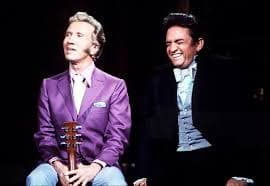
A ballad where death speaks softly, and the West mourns in quiet dignity
Within the long, dust-laden tradition of American folk balladry, Streets of Laredo stands as one of its most enduring elegies, and when interpreted by Marty Robbins and Johnny Cash, it becomes something even more profound. Though not a chart-driven single in the commercial sense upon its release, their rendition—associated with the broader body of Western recordings that defined albums like Gunfighter Ballads and Trail Songs for Robbins and Cash’s numerous explorations of frontier themes—exists beyond metrics. It belongs instead to the lineage of songs that were never meant to dominate charts, but to endure across generations.
At its core, Streets of Laredo is a narrative of finality. The story unfolds with stark simplicity: a dying cowboy recounts his fate, his regrets, and his quiet acceptance. Yet in the hands of Marty Robbins and Johnny Cash, the song transcends its traditional roots. Robbins brings a haunting clarity, his voice measured and almost tender, as if honoring the solemnity of the tale. Cash, by contrast, grounds the narrative with a baritone weight that feels like the voice of the earth itself—steady, inevitable, and unflinching.
The origins of the song trace back to an old Irish ballad, evolving through oral tradition before settling into the American West. By the time it reached artists like Johnny Cash and Marty Robbins, it had already become part of the cultural fabric—a song carried by cowboys, soldiers, and storytellers alike. What makes their interpretations remarkable is not reinvention, but preservation. They do not attempt to modernize the song’s essence; instead, they lean into its stillness, allowing the listener to inhabit its world.
Lyrically, the song is disarmingly direct. There are no elaborate metaphors, no hidden meanings. A young man faces death and asks only to be remembered with dignity. Yet within that simplicity lies its emotional gravity. The imagery of boots, spurs, and a slow procession through Laredo paints a scene that feels both specific and universal. It is not just the death of a cowboy, but the quiet passing of youth, of pride, of a life lived too quickly.
Musically, the arrangement often remains sparse, respecting the song’s origins. This restraint is crucial. It creates space for silence, and in that silence, the weight of the narrative settles. When Johnny Cash delivers a line, it feels like a final statement. When Marty Robbins follows, it feels like memory itself echoing back.
There is a reason Streets of Laredo continues to surface in recordings across decades. It speaks to a universal human condition: the confrontation with mortality and the desire for grace in its presence. In the interpretations by Marty Robbins and Johnny Cash, the song does not dramatize death. It accepts it, quietly, almost reverently.
And in that acceptance, it achieves something rare. It transforms a simple folk ballad into a timeless meditation on how a life, no matter how fleeting, longs to be remembered with honor.