
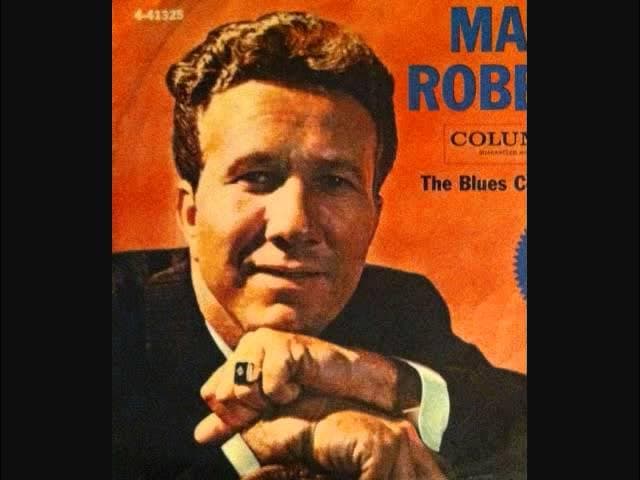
A Tender Graduation Day Fantasy Becoming a Promise
When Marty Robbins released “Cap and Gown” in May 1959 on Columbia Records, the single climbed to #45 on the Billboard Hot 100, marking a modest but meaningful crossover moment in the catalog of a man already steeped in romance and nostalgia. Backed with “Last Night About This Time,” the song is not part of one of his now-iconic western albums, but stands alone as a poignant snapshot of youthful longing.
At its heart, “Cap and Gown” is a wistful vision: a young man sees his sweetheart in her graduation robe, but in his mind, it becomes a bridal dress. He imagines the graduation ring on her finger transforming into a wedding ring, and when the school sings its alma mater, his own heart hears a wedding song instead.
Robbins didn’t write the song himself — it was composed by the prolific songwriting duo Sid Tepper and Roy C. Bennett, whose partnership spanned decades and yielded hits for many artists. Their knack for blending innocence and romantic fantasy is nowhere more evident than in this simple but evocative lyric.
Musically, “Cap and Gown” leans into the soft-pop-country style that Robbins could inhabit so gracefully. His smoky, warm voice carries a gentle assurance, as though he’s painting this graduation scene from memory or daydream, and inviting the listener into his reverie. The arrangement is understated and tender — delicate strings or soft backing vocals (depending on the recording) that never overwhelm, but instead cradle the emotional core.
Lyrically, the song is remarkable in its restraint. Robbins doesn’t spell out overt passion or dramatic heartbreak. Rather, he gives us a quiet fantasy built out of ceremony — graduation — and quietly folds in the deeper, more enduring fantasy of marriage. The graduation ring isn’t sufficient for him: he imagines the wedding ring. The alma mater isn’t enough: in his mind, they’re already singing their wedding song. That duality — the public ritual and the private devotion — is the song’s emotional engine.
One of the most affecting lines comes when he sings, “What I imagine you’d imagine too / On our graduation day.” It’s not just his fantasy; he dares to hope that she sees the same bridge between student life and married life, that she too will imagine something more than the moment itself.
Though “Cap and Gown” was never the towering hit that “El Paso”, released later that year, would become, it occupies a gentler corner of Robbins’s oeuvre. It reflects his versatility: the same man who could narrate vivid tales of the Old West could also tenderly articulate the quiet hopes of a young lover on the brink of life’s next ceremony.
In the broader context of Robbins’s career, “Cap and Gown” stands as a delicate elegy to youth, aspiration, and committed dreams. It may not shake the saloon walls or ride shotgun across dusty trails, but it resonates with the same sincerity — a reminder that among Robbins’s many voices was one quietly longing, hopeful, and deeply human.