
A country balladeer steps into a promise of devotion where tenderness speaks louder than grandeur.
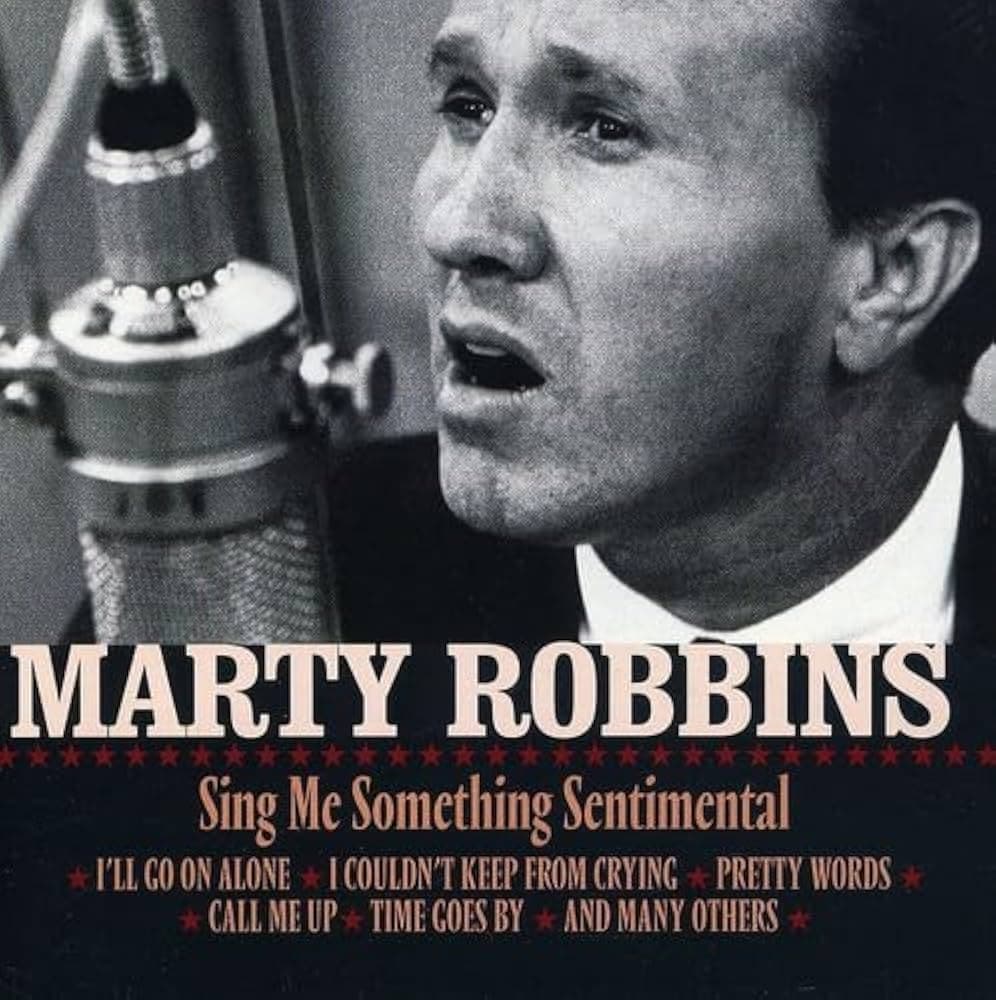
When Marty Robbins recorded Love Me Tender, the song arrived not as a chart driven event but as a quiet interpretive statement within his RCA catalogue, a performance that was never positioned as a major charting single. The recording was issued during his prolific studio years and later preserved on album releases and compilations drawn from that era, placing Robbins in direct conversation with one of the most enduring love songs in American popular music. Originally immortalized in the 1950s, Love Me Tender carried immense cultural weight long before Robbins ever approached it, which makes his version less about commercial ambition and more about artistic perspective.
What distinguishes Robbins’ reading is restraint. Where other interpretations lean into cinematic romance, Robbins approaches the song as a private vow. His voice, already known for its emotional steadiness and plainspoken sincerity, strips the lyric of spectacle and restores it to its emotional core. This is not a performance designed to overwhelm. It is designed to reassure. The words love me tender, love me true become less a declaration than a request offered with humility, as though permanence itself were something to be handled carefully.
The song’s melody, adapted from the 19th century ballad Aura Lee, has always carried a sense of inherited memory, and Robbins understands that lineage instinctively. He sings as a custodian rather than a reinterpreter, allowing the familiar structure to remain intact while subtly shifting its emotional temperature. His phrasing is unhurried. Each line settles gently, mirroring the song’s central promise of constancy rather than passion. In Robbins’ hands, love is not urgent. It is enduring.
Lyrically, Love Me Tender is almost radical in its simplicity. There is no narrative conflict, no dramatic arc. It exists entirely in the present tense, built on reassurance and mutual trust. Robbins leans into this stillness. Coming from an artist whose catalog includes gunfighter epics and heartbreak ballads, this choice is revealing. It shows a singer unafraid of quiet moments, confident that emotional truth does not require embellishment.
Culturally, Robbins’ version occupies an interesting space. It stands as an example of how classic material migrates across genres without losing its emotional identity. His country inflection does not alter the song’s meaning. Instead, it deepens it, grounding romantic idealism in lived experience. The tenderness feels earned, shaped by years of musical storytelling and emotional realism.
In retrospect, Marty Robbins did not record Love Me Tender to redefine it. He recorded it to listen to it from another angle. His interpretation reminds us that great songs are not monuments fixed in time but living works capable of reflection. In this version, tenderness becomes an act of faith, and love is measured not by intensity but by the quiet courage to remain.