
A Haunting Echo of Love That Refuses to Let Go
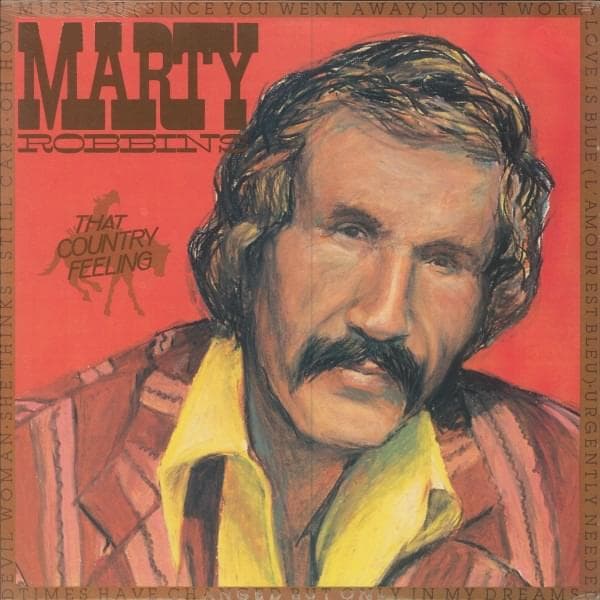
“She Thinks I Still Care” as rendered by Marty Robbins is a tender confession of lingering heartache dressed in gentle vulnerability, capturing the ache of someone who tries to convince the world — and perhaps himself — that he’s moved on, while every lyric betrays otherwise.
Robbins’ version appears on his 1968 album, I Walk Alone, released by Columbia Records. Though it was never his signature hit on the charts — the most enduring chart success belongs to George Jones, whose 1962 original spent six weeks at No. 1 on the Billboard country chart. Robbins’ recording came later; while it may not have eclipsed Jones’s in commercial dominance, his interpretation adds a different emotional shade, a reflective melancholy borne of maturity.
Robbins was not the first to sing “She Thinks I Still Care” — the song was written by Dickey Lee and Steve Duffy and first became a massive hit for George Jones in 1962. That version is widely considered definitive, emblematic of classic honky-tonk heartbreak. But when Robbins revisited it, he brought with him a lifetime of experience, a voice already steeped in both romantic adventure (“El Paso”) and soulful introspection (“I Walk Alone”).
Robbins’ interpretation is smoother and more measured than Jones’s raw lament. His vocal delivery feels like a late-night confession, as if he’s leaning back with a whiskey glass in hand, speaking softly into the darkness. Where Jones’s version crackles with immediate pain, Robbins’ feels more resigned — not oblivious to his own emotional turmoil, but weary of bearing it. The arrangement mirrors this restraint: the instrumentation is unobtrusive, leaving ample space for quiet corners in the melody to breathe, for sadness to settle in.
Lyrically, the song is deceptively simple. The narrator repeatedly says “just because” — just because he asks about her, just because he speaks her name, just because he rang her number “by mistake.” These small, casual admissions are his way of denying that she still matters. But each “just because” rings hollow. The very confidence of his denial underscores how deeply he feels her absence. He claims he doesn’t know where she lives now, but the detail in his memory betrays him; he’s still mapped the corners of her world. He insists he doesn’t care if she’s happy, but his preoccupation with her contentment betrays that love — or regret — still rules him.
What makes Robbins’ version so moving is that it does not merely echo Jones’s heartbreak; it reshapes it. In Robbins’ voice, there is not only the hurt of loss, but the silent dignity of someone who has lived, loved, and learned that pretending to forget is perhaps harder than learning to live with what remains. There is no desperate pleading, but a tender submission to the truth: he may have tried to move on, he may have wanted to prove she no longer mattered, but in his heart — and perhaps in his solitude — she still does.
In the broader tapestry of country music, Robbins’ “She Thinks I Still Care” stands as a testament to the timelessness of the song. It’s not just a cover — it is a reinterpretation informed by the wear and wisdom of a seasoned singer. For those who listen, his voice offers a softer, more reflective heartbreak, reminding us that regrets age, memories deepen, and true longing never fully fades.