
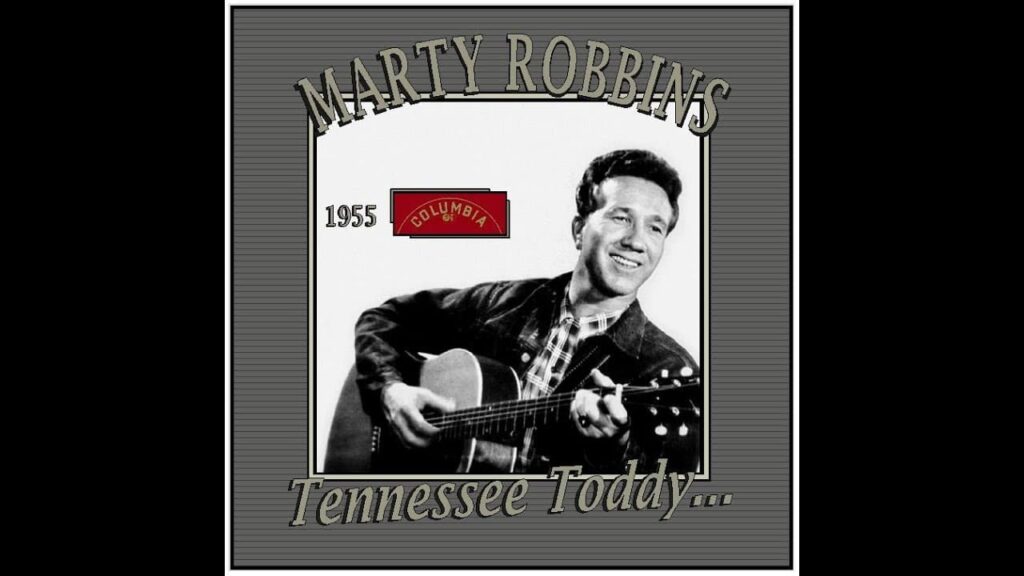
A rollicking chase of temptation and trouble that reveals how charm, danger, and desire can collide in a single outlaw smile
In 1953, Marty Robbins delivered one of his early chart successes with Tennessee Toddy, a lively single that climbed to Number 7 on the Billboard country chart and affirmed his rising stature on the postwar Nashville scene. Issued during a formative period before the sweeping epics of Gunfighter Ballads and Trail Songs, the track stands as an early indicator of Robbins’s instinct for narrative showmanship. Although not tied to a full studio album at the time, its presence in his growing repertoire helped shape the image of a singer who could inhabit stories with remarkable color and wit.
Tennessee Toddy thrives on the interplay between flirtation and folly, built on Robbins’s gift for crafting characters who feel vivid yet delightfully larger than life. The song unfolds as a quick stepping tale about a young woman whose beauty proves both irresistible and hazardous. Robbins sings with a bright, almost playful tension that mirrors the protagonist’s spiraling misadventure, and through his phrasing, the listener senses how easily a single moment of attraction might slide into chaos. The narrative moves with cinematic clarity. Toddy’s teasing, the pull of her presence, the growing suspicion, and the final twist all flow with the smooth confidence of a storyteller who already understood how to hook an audience.
The song’s structure supports that narrative flair. Robbins leans into an upbeat rhythmic swing that evokes taverns, small town crossroads, and the kind of mischievous evening where one poor decision can echo far into the morning. His voice maintains a youthful lightness, yet underneath it rests a knowing warmth, the kind that suggests he is not condemning his hapless hero so much as acknowledging a universal truth. Attraction has a way of disarming even the best intentions, and in the world Robbins sketches, consequences arrive fast.
Lyrically, Tennessee Toddy blends humor with caution. Toddy herself emerges as more than a stock character; she represents the unpredictable spark that can ignite a chain reaction in an otherwise ordinary life. Robbins avoids portraying her as villain or victim. Instead, she becomes an emblem of that dangerous allure that country music, especially in the early fifties, loved to explore. The song’s joy lies not only in the chase but in the recognition of human frailty. People stumble into temptation. People misread charm as safety. People fall because they cannot help but lean closer.
Over the decades, Tennessee Toddy has remained a charming artifact of Robbins’s artistic evolution. It captures the moment before he stepped into the grand mythmaking that would later define his legacy. The ingredients are already present. The actor’s instinct. The storyteller’s rhythm. The singer’s empathy. What began as a charting single in 1953 now reads like a blueprint of the entertainer he would become, proof that Robbins understood long before the world did how to turn a simple tale into something timeless.