
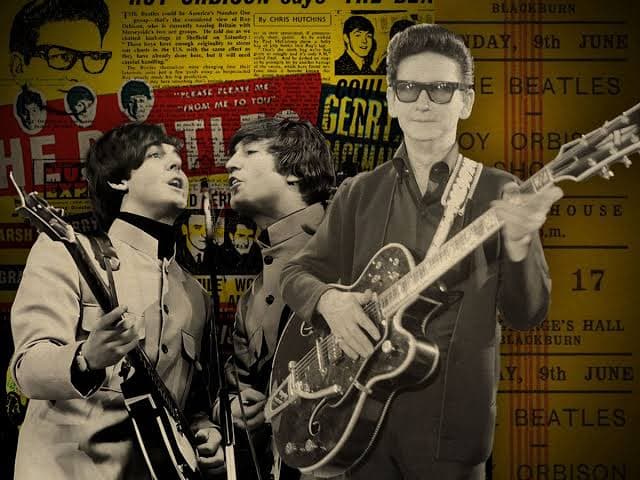
A voice so towering it briefly eclipsed even the dawn of Beatlemania
In 1963, at the height of his early dominance on the charts, Roy Orbison stood as one of America’s most formidable hitmakers, with songs like Only the Lonely and Running Scared already securing high positions across both US and UK charts. Touring Britain that year alongside The Beatles, Orbison was not merely a supporting act—he was, at least initially, the headliner. Though not tied to a single album cycle in the traditional sense of later rock tours, this moment unfolded during a period when Orbison’s recordings were defining the emotional architecture of early 1960s pop.
What transpired on that tour has since taken on an almost mythic quality. Night after night, Roy Orbison would walk onto the stage, dressed in black, motionless beneath the lights, and deliver performances that felt less like concerts and more like emotional reckonings. His voice—operatic, trembling, and impossibly controlled—cut through the restless energy of the crowd. It was a presence that demanded stillness, an unusual feat in an era increasingly driven by youthful frenzy.
Accounts from those performances suggest a striking contrast. When The Beatles took the stage, the atmosphere erupted into ecstatic chaos. Screams, movement, a kind of cultural ignition. But when Orbison performed, something entirely different happened. The noise receded. Audiences listened. Truly listened. It was not spectacle in the conventional sense—it was absorption. For a fleeting moment, the emotional gravity of Orbison’s music seemed to overshadow even the surging phenomenon of Beatlemania.
This was not a competition of popularity, but of emotional weight. Roy Orbison operated in a different register altogether. Where many artists of the time celebrated love in its youthful immediacy, Orbison explored its fragility, its longing, and its inevitable heartbreak. Songs like Crying and In Dreams did not merely tell stories—they exposed inner worlds. On stage, this translated into performances that felt deeply personal, almost confessional.
There is a deeper significance to this moment in 1963. It represents a crossroads in popular music history. On one side stood Orbison, embodying a tradition of meticulously crafted, emotionally intense songwriting. On the other stood The Beatles, heralding a cultural shift toward self-contained bands, youthful identity, and a new kind of global phenomenon. That Orbison could momentarily eclipse them speaks not to a rivalry, but to the sheer magnitude of his artistic voice.
In retrospect, the image endures: a solitary figure, barely moving, commanding an audience not through spectacle but through sincerity. Roy Orbison did not need to compete for attention. He transformed it. And in doing so, he left behind one of the most quietly powerful chapters in live music history—one where, for a brief and unforgettable stretch, emotion itself became louder than the noise of a generation.