
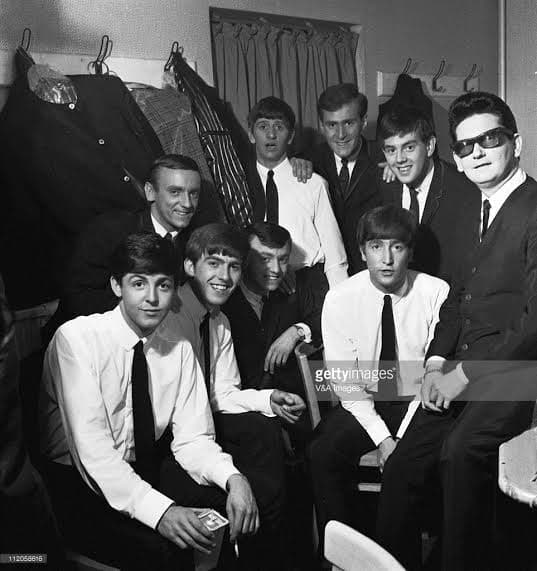
Clash of Shadows and Screams: When Operatic Heartbreak Met the Birth of Beatlemania
In 1963, as Roy Orbison embarked on his UK and European tour alongside The Beatles, the charts told a story of seismic transition. Orbison arrived not as an unknown supporting act, but as a proven hitmaker whose singles like “Only the Lonely” and “In Dreams” had already secured Top 10 placements in both the United States and the United Kingdom. His 1962 album Crying had solidified his reputation as rock and roll’s most operatic romantic. Yet on this tour, the billing placed him above a young Liverpool quartet whose early singles were just beginning to ignite a cultural firestorm. Within months, that hierarchy would invert forever.
The tour remains one of the most fascinating intersections in popular music history. Orbison, clad in black, immobile behind dark glasses, projected an almost gothic stillness. His voice, however, was anything but static. It soared in improbable crescendos, moving from velvet baritone to near-tenor heights without visible strain. British audiences, accustomed to the raw exuberance of Merseybeat, encountered something altogether different: emotional grandeur, meticulously constructed arrangements, and a kind of romantic fatalism that felt closer to grand opera than to dancehall rock.
At first, Orbison was the headliner. Reports from the tour describe how he would deliver encore after encore, compelled back to the stage by thunderous applause. It was not bravado that defined him but discipline. His songs were architecturally precise, built on dramatic tension and release. Yet each night, after his final bow, The Beatles would take the stage. And something elemental shifted. The screaming began. The atmosphere changed from reverent admiration to ecstatic hysteria.
What unfolded across the UK and Europe was less a rivalry than a relay of eras. Orbison represented the culmination of early rock’s introspective, orchestral ambition. The Beatles, by contrast, embodied acceleration—shorter songs, sharper hooks, collective charisma. Orbison himself reportedly recognized the inevitability of the change. Rather than bristle at the growing frenzy surrounding his tourmates, he observed it with a quiet understanding. He had mastered the language of longing; they were about to rewrite the grammar of youth culture.
There is a poignant symmetry in this moment. Orbison’s art was rooted in isolation, in the solitary figure under a spotlight singing of unrequited love. The Beatles introduced communion—four voices, shared spotlight, shared hysteria. The 1963 tour thus stands as a hinge in music history: the twilight of one emotional vocabulary and the dawn of another.
For those who listen closely, that tour was not about who closed the show. It was about how two distinct visions of popular music briefly shared the same stage, illuminating each other in the process. In the echo between Orbison’s soaring laments and the Beatles’ electrified choruses, one can hear the precise moment the 1960s found its pulse.