
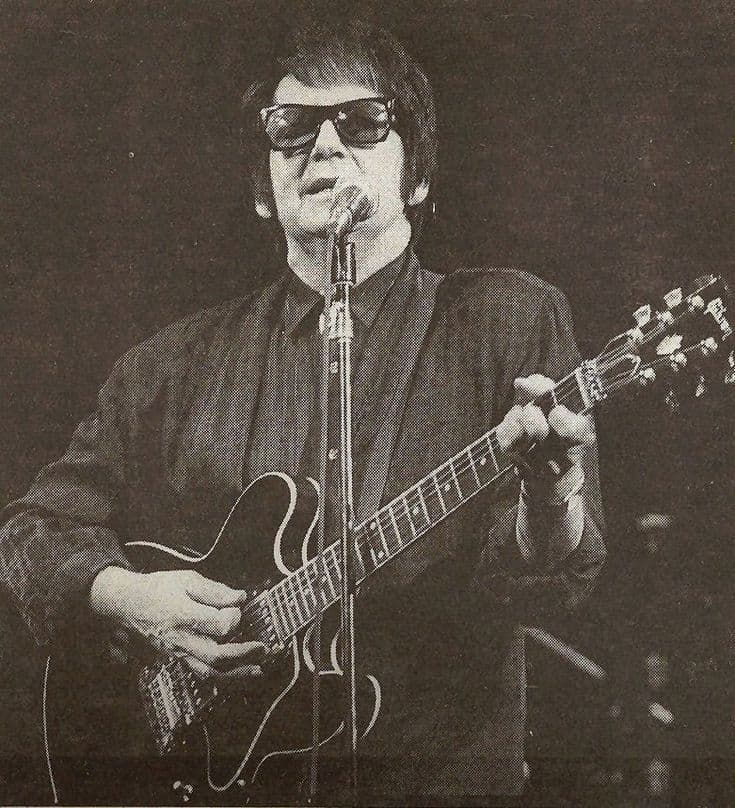
The Roaring Cry of a Man Ensnared by a Woman’s Wild, Untamable Power
Oh, to be transported back to the golden age, to a time when a simple three-minute single could feel like the whole world revolving around a story of heartbreak and fire! The music of Roy Orbison holds a special place in the collective memory, not just for his signature ballads that soared to the heavens, but for those powerful, earthier tracks that reminded us he was a true master of the rock and roll genre. Among them, the furious, almost unbridled energy of “Mean Woman Blues” stands out—a glorious, joyful, yet deeply felt lament about a love that’s as exhilarating as it is ruinous.
Chart Success and Historical Context
When Roy Orbison’s rendition of “Mean Woman Blues” hit the airwaves on August 1, 1963, it was a certified smash. Released on the Monument label, this rock and roll powerhouse was the A-side of a single that also featured the now-legendary ballad “Blue Bayou.” The pairing was a stroke of genius, showcasing the breathtaking breadth of Orbison’s talent.
In the United States, “Mean Woman Blues” charged up the charts, peaking at Number 5 on the prestigious Billboard Hot 100 singles chart. The contrasting B-side, “Blue Bayou,” also performed respectably, hitting number 29, but it was the raw, driving rhythm of the “mean woman” that initially dominated the American airwaves. Across the pond in the UK, the story was slightly different, with the single issued as a double A-side that soared to a joint peak of Number 3, illustrating the unparalleled adoration the British audience already held for “The Big O.” This dual success in 1963 placed Orbison firmly in the upper echelon of global pop royalty, reinforcing his unique position as a vocal phenomenon who could switch seamlessly between soaring operatic melodrama and blistering, hip-shaking rockabilly.
The song itself was not an original for Orbison; it was actually penned by the seasoned songwriter Claude Demetrius and originally recorded by none other than Elvis Presley for the soundtrack of his 1957 film, Loving You. However, in the hands of Roy Orbison, who recorded his version in April 1963, the track takes on a new, darker, and more manic intensity.
The story is a classic, straight-forward blues narrative: a man is absolutely captivated by a woman who is, simply put, bad news. She’s “mean as she can be,” and he knows it, yet he can’t walk away. The lyrics paint her as a captivating temptress with “ruby lips” and “shapely hips,” a figure of irresistible physical allure who makes “old Roy-oy flip.” The brilliance of Orbison’s interpretation lies in the performance. While Presley’s original was a swaggering rocker, Orbison’s vocal delivery is a manic, almost desperate outpouring. He doesn’t just sing the words; he shouts them, transforming the typical twelve-bar blues structure into a frantic confession. This is not the voice of a smooth ladies’ man; it is the voice of a man utterly possessed, a brilliant man who has lost all control to a woman who is his beautiful undoing.
The deeper meaning, particularly for those of us who remember those times, rests in this conflict. It’s the universal, timeless struggle between logic and passion. The song is an anthem for anyone who has ever been in a relationship they knew was wrong—toxic, consuming, and leading nowhere good—but felt powerless to end because the intensity of the feeling was all-encompassing. The frantic pace, the sharp, driving rhythm section (courtesy of Nashville’s famed A-Team session musicians), and Orbison’s passionate wail are the perfect musical embodiment of this inner turmoil, capturing the frenzied, desperate energy of a love-hate bond. It’s a nostalgic nod to an era when rock and roll was at its most primal and direct, a glorious sound that still makes the pulse quicken and reminds us that some of the greatest songs are built on the simplest, most human of emotions.
It’s a testament to the enduring power of both the song and the man that this track was a high-energy centerpiece of the legendary 1987 television special, Roy Orbison and Friends: A Black & White Night, where he performed it alongside rock titans like Bruce Springsteen and Elvis Costello, proving that the raw, captivating energy of the “Big O” was truly timeless.
You can get a sense of the classic rock and roll vibe of this track by listening to this original recording: Mean Woman Blues by Roy Orbison. This video provides the original audio for Roy Orbison’s 1963 recording, which was the A-side single that peaked at Number 5 on the Billboard Hot 100 chart.