
A Rockabilly Storm Reborn Through the Voice of a Survivor
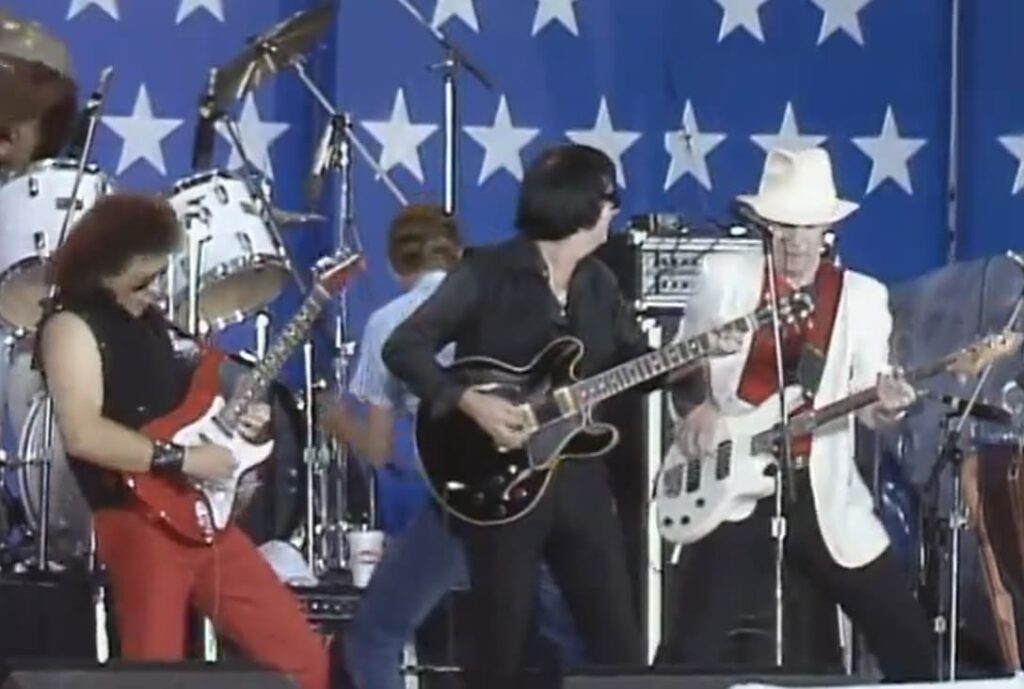
When Roy Orbison stepped onto the stage at Farm Aid in September 1985 and launched into “Mean Woman Blues,” he was not introducing a new song to the world—he was reviving one of the defining records of his early career. Originally released as a single in 1963 and later included on the album In Dreams, the song became one of Orbison’s biggest up-tempo hits, reaching No. 5 on the Billboard Hot 100. More than two decades later, at the first Farm Aid concert in Champaign, Illinois, Orbison brought that same explosive energy before an audience gathered for one of the most significant benefit events of the decade.
What makes “Mean Woman Blues” so fascinating within the Roy Orbison catalog is its contrast with the image most listeners carry of him. Orbison is often remembered as the master of heartbreak—the man behind “Crying,” “Only the Lonely,” and “In Dreams.” His voice seemed built for loneliness, longing, and emotional devastation. Yet “Mean Woman Blues” reveals another side entirely: a performer deeply rooted in the raw, restless spirit of rockabilly.
Written by Claude Demetrius and first popularized by Elvis Presley in 1957, the song is less a tale of suffering than a celebration of chaos. The woman at its center is wild, unpredictable, and impossible to control. Rather than portraying himself as a tragic victim, the narrator sounds almost thrilled by the turmoil. It is a classic rock-and-roll paradox—the very qualities that make love dangerous are the ones that make it irresistible.
Orbison’s version transforms the song through sheer vocal authority. Unlike many rockabilly singers who relied on swagger, Orbison relied on power. His voice rises above the driving rhythm section with a force that feels almost operatic. Even when singing a playful, hard-driving rocker, he cannot help sounding larger than life. The result is a recording that bridges two worlds: the rebellious energy of 1950s rock and roll and the vocal sophistication that would define Orbison’s greatest achievements.
The 1985 Farm Aid performance carries additional emotional weight when viewed through the lens of history. By that point, Orbison had endured years of personal tragedy and career fluctuations, yet he remained one of the most respected figures in American music. Sharing a bill with artists ranging from Willie Nelson to Bob Dylan, he stood as a living link to the foundational era of rock and roll. His Farm Aid set included “Crying,” “Mean Woman Blues,” and “Oh, Pretty Woman,” a concise reminder of the extraordinary range that had made him a legend.
Listening to “Mean Woman Blues” today, especially in its Farm Aid incarnation, is to hear more than a hit song. It is the sound of Roy Orbison reconnecting with the youthful fire that launched his career. The performance crackles with confidence, humor, and momentum, proving that beneath the dark glasses and the heartbreak ballads remained a rock-and-roll pioneer who could still ignite a crowd with a single shout. In that moment, the song became more than a nostalgic revival—it became a testament to endurance, reminding listeners that great artists never truly outgrow the music that first set them free.