
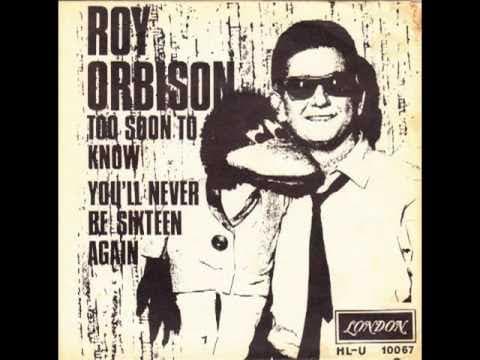
TOO SOON TO KNOW captures the aching uncertainty of love and loss with a voice that feels suspended between confession and lament
Upon its release in 1966 as the lead single from Roy Orbison Sings Don Gibson, “Too Soon To Know” became one of Roy Orbison’s most affecting interpretations of another writer’s material, reaching number three on the UK Singles Chart and enjoying notable chart placements in Ireland and Australia while peaking modestly at number 68 on the U.S. Billboard Hot 100. The track was later remastered in 2015 for reissue on compilations and box sets that revisit Orbison’s mid-1960s output, preserving its elegiac beauty for contemporary listeners.
In the context of Orbison’s career, “Too Soon To Know” occupies a singular emotional terrain. Written by country songwriter Don Gibson, whose catalog already contained a litany of heart-worn laments, the song was not originally penned for Orbison; it had been recorded by Gibson himself in the late 1950s. Yet when Orbison took it into the studio in Nashville under the auspices of producers Wesley Rose and Jim Vienneau, he transformed it into something deeply personal, even autobiographical in tone. That transformation was amplified by the tragic context of Orbison’s life at the time: the sudden death of his wife Claudette in a motorcycle accident in June 1966 cast a long shadow over his work, and although “Too Soon To Know” was not written with that event in mind, many listeners and critics perceived its plaintive uncertainty as a reflection of Orbison’s own grief.
Musically the song unfolds with the sort of orchestral restraint that was emblematic of Orbison’s mid-60s style. Strings and gentle piano punctuate the arrangement, giving the performance a widescreen melancholic sheen that complements the vulnerability in Orbison’s voice. His delivery, always remarkable for its range and emotional directness, never sounds forced here; instead he inhabits these lines as if negotiating the razor’s edge between memory and hope. The refrain’s central question—whether one can ever forget a love that has ended—becomes a universal meditation on heartbreak because Orbison refuses theatrical excess in favor of subtle phrasing and a resigned sincerity.
Lyrically, “Too Soon To Know” articulates that fragile liminal space after a relationship’s collapse. The verses give voice to the internal dialogue of someone adrift, uncertain when time will begin to heal or if it ever truly does. Lines like “My heart’s been broken in too many pieces” resonate because they do not promise resolution; they simply acknowledge the rawness of the present moment. This thematic openness is part of what has allowed the song to endure. It does not bind itself to a specific narrative outcome but instead embraces the universality of human hurt.
The cultural legacy of “Too Soon To Know” lies not in blockbuster commercial success, but in its capacity to reveal Orbison’s interpretative genius. In choosing to record material by others and shaping it into something unmistakably his own, Orbison affirmed that the emotional core of a song can transcend its origins. “Too Soon To Know” stands as a testament to that craft: a moment where vocal expression and lyrical ambiguity intersect to create a piece of timeless introspection. For serious listeners attuned to the deeper currents of Orbison’s work, it remains a quiet but profound gem in a catalog defined by emotional honesty and vocal mastery.