
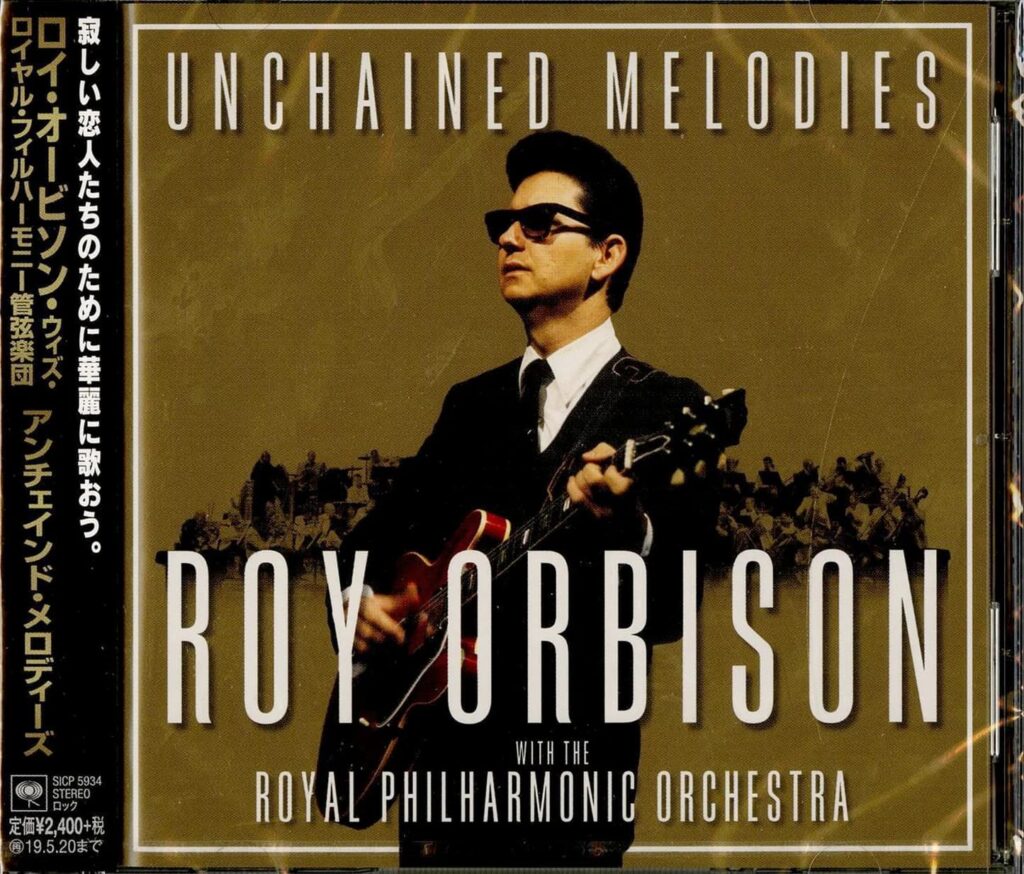
A voice suspended between longing and eternity, where love waits patiently beyond time itself
Upon its release within Roy Orbison’s 1965 album Unchained Melodies, Unchained Melody occupied a unique position in popular music history. Unlike some renditions that surged immediately up the charts, Orbison’s interpretation was not issued as a defining chart single upon release. Instead, it lived within the context of an album devoted to timeless standards, allowing its power to unfold gradually rather than explosively. This placement proved fitting. Unchained Melody has never belonged solely to the moment of its release. It belongs to memory, to waiting, and to the quiet ache that survives long after applause fades.
Originally composed by Alex North with lyrics by Hy Zaret in 1955, Unchained Melody was already a song burdened with emotional gravity long before Orbison approached it. Its narrative voice speaks from a place of separation, devotion stretched thin by time, distance, and uncertainty. What Roy Orbison brings to the composition is not reinvention, but deep excavation. His voice does not merely sing the melody. It exposes it, revealing the song’s emotional marrow with a restraint that is almost painful.
Orbison’s vocal performance is notable for what it refuses to rush. Where other versions lean into dramatic crescendos, his phrasing lingers, as though each line must be weighed before release. This approach transforms the song from a declaration into a vigil. Love, in Orbison’s hands, is not triumphant. It is faithful. The famous opening lines unfold with reverence, establishing not desire but patience. The singer does not demand return. He waits for it.
Musically, Orbison’s version remains spare and reverent. The arrangement supports rather than competes with the vocal line, allowing space for breath, silence, and reflection. This restraint aligns perfectly with Orbison’s broader artistic identity. Throughout his career, he excelled at portraying emotional vulnerability without sentimentality. On Unchained Melody, that skill reaches a quiet apex. The song becomes less about romantic reunion and more about endurance. It speaks to the kind of love that survives absence, that grows deeper in stillness rather than proximity.
Culturally, Unchained Melody is often associated with grand gestures and cinematic romance. Orbison subtly reclaims it from spectacle. His interpretation suggests something more intimate and arguably more truthful. Love is not always loud. Sometimes it is a voice alone in a room, singing not to be heard, but to remain connected. This reading resonates deeply with listeners who understand love not as fantasy, but as commitment tested by time.
Within Unchained Melodies, the song stands as both centerpiece and confession. It reflects an artist at ease with vulnerability, unafraid to let silence speak alongside sound. Roy Orbison does not attempt to own Unchained Melody. He honors it, allowing its sorrow and hope to coexist without resolution.
In the end, Orbison’s Unchained Melody is not defined by chart position or commercial impact. Its legacy lies elsewhere. It endures because it understands the quiet truth at the heart of longing. Some loves are not meant to be shouted. They are meant to be carried, patiently, across time.