
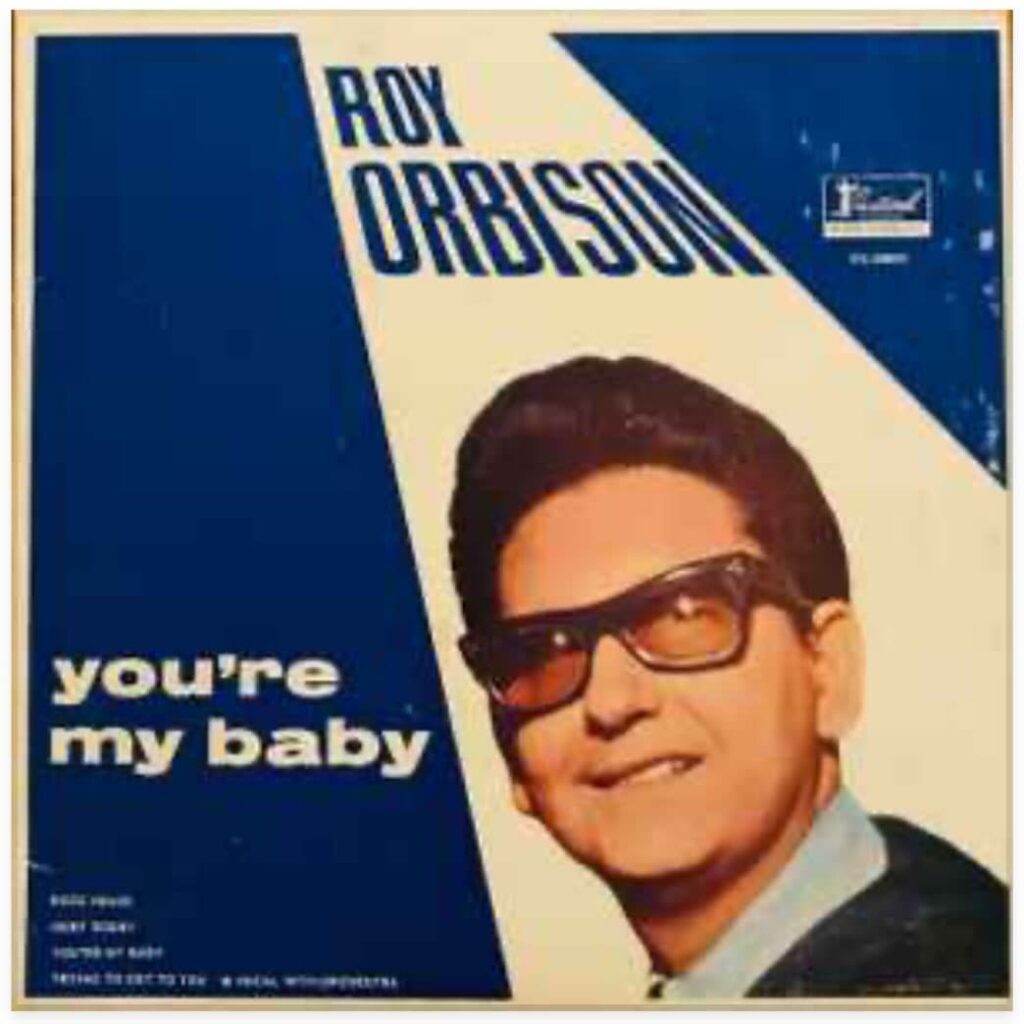
A youthful declaration of devotion where innocence meets the first tremors of longing
Before the sweeping orchestrations and operatic heartbreak that would later define his legend, Roy Orbison introduced himself to the world with a far more stripped-back urgency in You’re My Baby, released as a single and associated with his early Sun Records period. While it did not achieve major chart success upon release, the song holds a crucial place in Orbison’s chronology, capturing the raw beginnings of an artist still shaping the contours of his voice. Long before albums like Crying or In Dreams would elevate him into a realm of near-mythic status, this recording reveals a young performer grounded in the directness of early rock and roll.
There is an unmistakable sense of immediacy in You’re My Baby. The arrangement is lean, driven by a rhythmic pulse that reflects the influence of the Sun Records sound, where energy often took precedence over polish. This is not the Orbison of grand crescendos and carefully layered arrangements. Instead, it is a version of him that feels closer to the roots of American rockabilly, where the song’s emotional impact relies on momentum and attitude as much as melody.
Vocally, however, even in this early stage, there are hints of what would come. Roy Orbison does not yet fully unleash the soaring range that would later become his signature, but there is already a distinct tonal clarity, a smoothness that sets him apart from many of his contemporaries. His delivery carries a quiet confidence, suggesting an artist who understands the emotional core of a song even before mastering its full expressive potential.
Lyrically, You’re My Baby operates within the familiar framework of early rock and roll romance. It is a straightforward declaration of affection, unburdened by the complexity and introspection that would later characterize Orbison’s work. Yet within that simplicity lies its charm. The song captures a moment before doubt, before loss, before the intricate emotional landscapes of adulthood begin to take shape. It is love expressed in its most immediate form, direct and unfiltered.
What makes the song particularly compelling in retrospect is the contrast it provides within Roy Orbison’s broader legacy. Listening to You’re My Baby with the knowledge of what followed, one hears not just a standalone recording, but the foundation of a remarkable evolution. The seeds of his later emotional depth are present, though not yet fully realized. The restraint in his vocal performance, the clarity of tone, the instinct for melody, all point toward an artist on the verge of transformation.
Within the context of his career, the song serves as a reminder that even the most distinctive voices begin somewhere grounded and unadorned. It documents a phase where Roy Orbison was still navigating the conventions of his time, absorbing influences, and quietly distinguishing himself from within them.
In the end, You’re My Baby endures not because of grand ambition, but because of its honesty. It captures a fleeting moment of artistic innocence, a point where love is simple, music is immediate, and a future legend is just beginning to find his voice.