
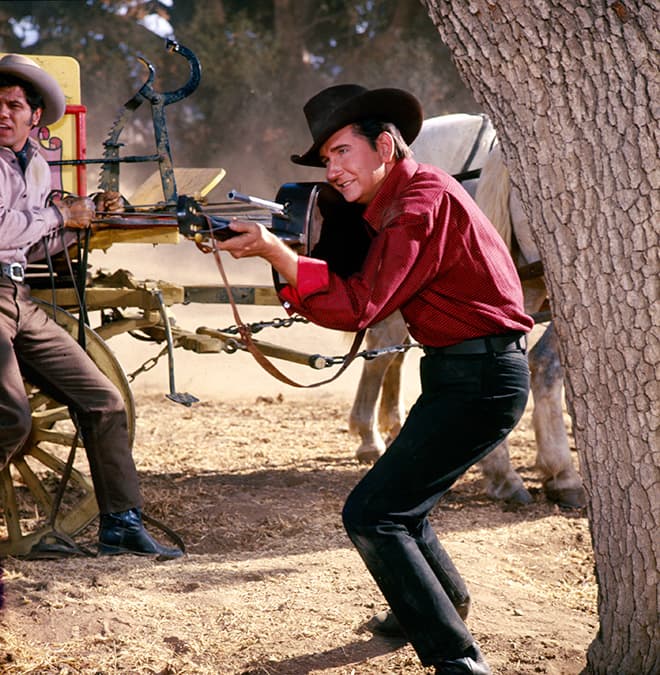
A mythic ride through the Wild West where rhythm becomes gunfire and the guitar speaks faster than words
Drawn from the soundtrack album The Fastest Guitar Alive, Roy Orbison’s The Fastest Guitar Alive occupies a curious and compelling corner of his catalog. Released in connection with his starring role in the film of the same name, the song did not achieve the towering chart success of his earlier hits, yet it stands as a vivid artifact of a moment when Orbison stepped beyond the recording studio and into cinematic storytelling. It is here, at the intersection of music and myth, that his artistry takes on an entirely different dimension.
The premise itself borders on folklore. A guitar that fires bullets faster than any gunman, a drifter navigating danger with both melody and misdirection, and a frontier world where legend is currency. In lesser hands, such material might collapse into novelty. But Roy Orbison, ever the master of emotional gravity, imbues the concept with a surprising sense of conviction. His voice, unmistakable in tone and phrasing, grounds the narrative, transforming what could be parody into something closer to myth-making.
Musically, The Fastest Guitar Alive departs from the orchestral sweep that defined many of Orbison’s most celebrated recordings. Instead, it leans into a brisk, almost playful rhythm, echoing the gallop of a horse across open plains. The arrangement carries a cinematic quality, each chord progression suggesting movement, pursuit, and tension. There is a deliberate lightness here, yet beneath it lies a craftsman’s precision. Orbison never abandons control, even when the song’s narrative flirts with exaggeration.
Lyrically, the song operates on two levels. On the surface, it tells the story of a man whose weapon is not a revolver but a guitar, turning music into both shield and spectacle. Beneath that, however, is a deeper reflection on identity. The protagonist is defined not by violence, but by performance, by the ability to transform danger into art. It is a subtle but meaningful inversion of the Western archetype. In Orbison’s world, expression becomes power.
This duality reflects Roy Orbison himself during this period. Known primarily for his haunting ballads and operatic crescendos, he was not an obvious candidate for a Western hero. Yet that contrast is precisely what gives The Fastest Guitar Alive its intrigue. He does not attempt to outgrow his persona. Instead, he carries it into a new setting, allowing the vulnerability and emotional depth of his voice to coexist with the bravado of the frontier myth.
Over time, the song has taken on the quality of a cultural curiosity, a piece that invites listeners to reconsider the boundaries of Orbison’s artistry. It reveals a willingness to experiment, to step into narrative spaces that challenge expectation. While it may not command the same reverence as his most iconic recordings, it offers something equally valuable: a glimpse into an artist unafraid to explore.
In the end, The Fastest Guitar Alive is less about speed than it is about transformation. It turns sound into spectacle, story into song, and a familiar voice into something unexpectedly cinematic. Within its playful mythology lies a deeper truth. Even in the wildest tales, Roy Orbison never ceased to be a storyteller first, shaping emotion with the same precision as any gunslinger might draw steel.