
A raw confession of devotion shouted into the working class night
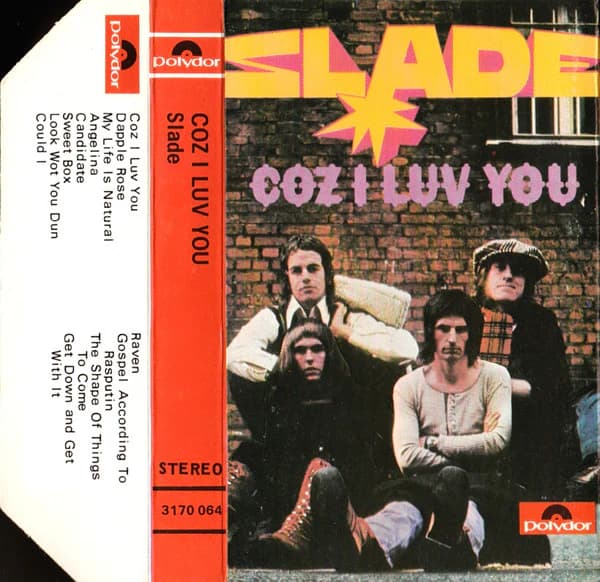
Released in 1971, Coz I Luv You by Slade stormed straight to number one on the UK Singles Chart, holding that position for four weeks and announcing the band as a defining force of the era. The song later became a centerpiece of the live album Slade Alive!, a record that captured the group at full voltage and preserved this single as both a chart triumph and a communal chant. At a time when British pop was splintering between polished studio craft and gritty street realism, Slade chose volume, blunt honesty, and emotional directness, and the public responded instantly.
At its heart, Coz I Luv You is disarmingly simple. The title alone declares its intent, spelled phonetically, defiantly unconcerned with refinement. This was not carelessness. It was a statement of identity. Lead vocalist Noddy Holder delivers the lyric not as a polished croon but as a roar that borders on desperation. Love here is not whispered. It is shouted, almost pleaded, as if the singer fears that restraint might dilute its truth. The misspelled words mirror the song’s emotional grammar. This is love felt more than articulated, driven by urgency rather than eloquence.
Musically, the song is built on elemental foundations. A piano that pounds rather than decorates, a rhythm section that moves with stomping insistence, and a melody that rises like a rallying cry. The structure is repetitive by design. Each return to the chorus feels less like redundancy and more like insistence, reinforcing the idea that love, when genuine, demands repetition. It must be said again and again because saying it once is never enough.
What elevates Coz I Luv You beyond novelty is its emotional transparency. There is vulnerability beneath the bravado. The lyric admits need without shame. In the context of early seventies Britain, this mattered. Slade spoke directly to an audience that rarely saw its own emotional language reflected in pop music. These were songs for factory floors, football terraces, and crowded pubs. The rough edges were the point. The imperfections made the feeling credible.
Culturally, the song helped define the blueprint for glam rock before the term had fully crystallized. Yet unlike later glam acts that leaned into artifice and theatrical distance, Slade remained grounded in physical presence and shared experience. Coz I Luv You was not about spectacle. It was about connection. Thousands of voices shouting the same misspelled words in unison turned personal affection into collective release.
Over time, the song’s legacy has only strengthened. It endures because it refuses to intellectualize emotion. It trusts feeling more than finesse. In the archive of British rock, Coz I Luv You stands as proof that sincerity, when delivered without apology and at full volume, can be timeless. It is not a love song that asks to be admired. It demands to be felt.