
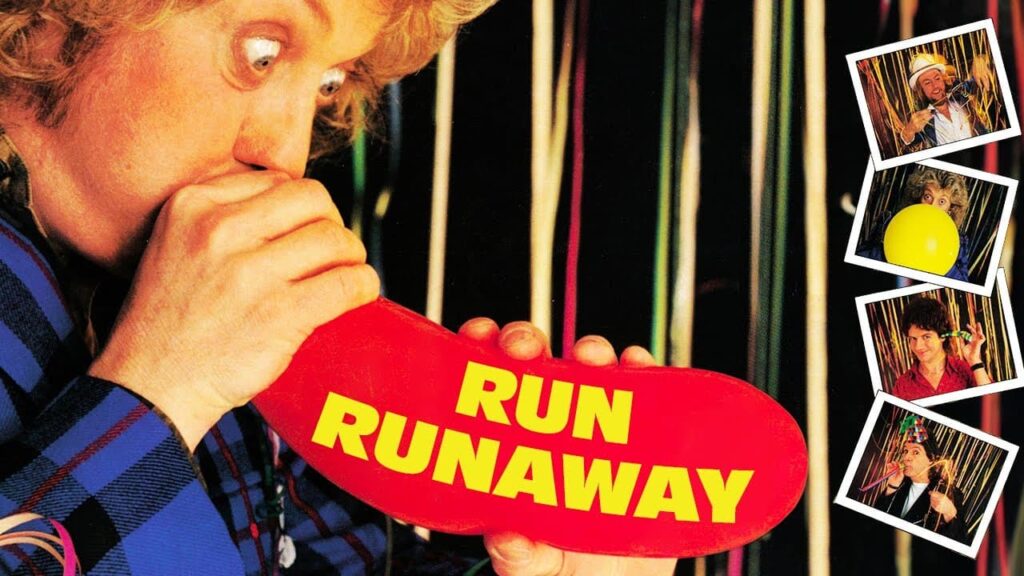
A defiant celebration of escape and endurance, this song turns motion itself into a declaration of survival.
When Run Runaway surged onto the charts in 1984, it marked a remarkable late era resurgence for Slade, reaching the UK Top 10 and breaking into the US Top 20 while anchoring the album Keep Your Hands Off My Power Supply. For a band often framed through the lens of early 1970s glam stomp and communal chant, this success mattered. It proved that Slade were not merely revisiting past glories but reasserting relevance in a decade shaped by synthesizers, MTV, and a cooler, more stylized approach to rock performance.
At its surface, Run Runaway is built on urgency. The tempo drives forward without hesitation, the rhythm relentless yet buoyant, and the melody carries a sense of uplift rather than desperation. This distinction is crucial. The song does not depict flight as fear. It frames escape as agency. To run is not to surrender, but to choose momentum over stagnation. In this way, the song resonates deeply with the early 1980s cultural mood, a period defined by reinvention, economic unease, and the need to move forward even when certainty was scarce.
Lyrically, the song relies on simplicity, a hallmark of Slade at their most effective. The words are direct, almost conversational, but they leave ample space for listeners to project their own meaning. There is no detailed narrative of what is being fled or what lies ahead. That ambiguity is intentional. It allows the song to function as a universal anthem for transition, whether personal, creative, or generational. The chorus does not ask permission. It insists on motion, on leaving the door open behind you rather than closing it with regret.
Musically, Run Runaway reflects a careful balance between adaptation and identity. The use of electronic textures and a more polished production places the track firmly within its era, yet the core remains unmistakably Slade. Noddy Holder’s vocal performance retains its raw, working class fervor, straining slightly at the edges in a way that communicates authenticity rather than polish. It is the sound of a band that understands its own voice and refuses to mute it for fashion.
The song’s enduring appeal lies in its emotional clarity. Unlike many songs about escape that dwell in anxiety or loss, Run Runaway is optimistic without being naive. It acknowledges pressure without naming it, and in doing so, it offers listeners a sense of permission. Permission to move on, to outgrow old versions of oneself, and to trust forward motion as a form of self preservation.
Within Slade’s catalog, Run Runaway stands as a testament to resilience. It captures a veteran band not looking back with nostalgia, but looking outward with resolve. Decades later, the song still feels alive because its central message remains timeless. Sometimes survival is not about standing your ground. Sometimes it is about knowing when to run, and running with conviction.