
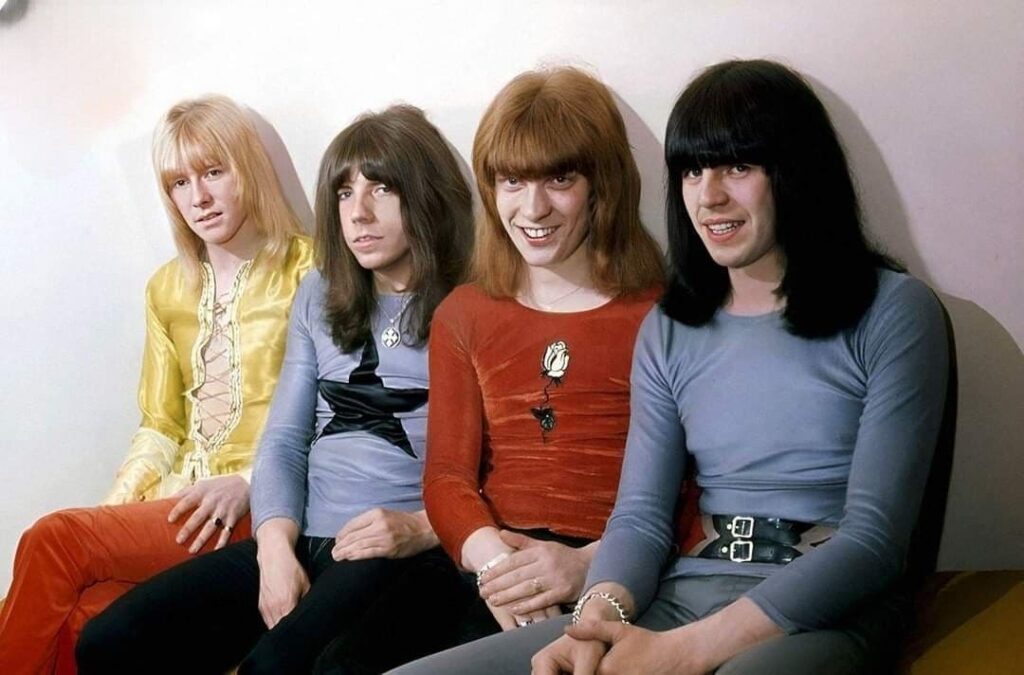
A quiet revelation of longing shaped into one of Sweet’s most atmospheric early recordings
In 1971, Sweet placed Honeysuckle Love on their debut album Funny How Sweet Co Co Can Be, a record known for its bold embrace of early glam textures and youthful swagger. Yet this track occupies a different emotional register. It was never issued as a charting single and therefore carried none of the commercial spotlight that surrounded the band’s hits. Its significance arises from its placement within the album’s sonic landscape. It stands as an intimate counterpoint to the group’s more electrified work, revealing a contemplative dimension that many listeners only discovered when exploring the album in full.
The story of Honeysuckle Love begins not with a documented anecdote or dramatic origin, but with the sound itself. The recording captures a band still shaping its identity, leaning into harmonies and soft rhythmic contours that reflect the transitional moment between late sixties melodic pop and the harder glam aesthetic that would define Sweet’s signature era. By focusing on the tonal palette rather than spectacle, the song invites a slower, more reflective engagement. The instrumental choices suggest an intentional softening of edges. Guitars glide rather than strike. Percussion sits in a gentle pocket. Vocals carry a warmth that contrasts beautifully with the band’s better known, high energy material.
Thematically, Hhoneysuckle Love evokes the imagery of youthful desire filtered through a pastoral lens. The title alone conjures sweetness intertwined with longing. Within the lyric, affection is presented as something both delicate and magnetic. This duality is reinforced by the composition. The chord progression moves with a subtle ebb that mirrors the emotional push and pull of quiet infatuation. Nothing in the arrangement rushes. Instead, the song allows its sentiment to unfold with deliberate tenderness.
The track’s legacy lies in its ability to challenge assumptions about Sweet’s early catalog. Listeners who approach the band expecting only glam bravado often find in Honeysuckle Love a surprising expression of vulnerability. Its restrained tone, melodic clarity, and atmospheric layering reveal musicians attentive to nuance and mood. In retrospect, it feels like a bridge between youthful pop craftsmanship and the more theatrical identity Sweet would soon embrace. That makes the song a meaningful artifact within their evolution.
For the seasoned listener revisiting the early seventies, Honeysuckle Love becomes a moment of discovery. It offers not spectacle but subtlety, not exuberance but emotional texture. It is a reminder that even within albums known for their bright colors and bold character, there exist quiet corners where a band lets its guard down and allows sincerity to guide the melody.