
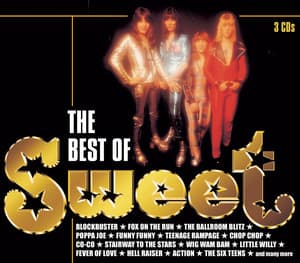
SWEET POWER AND PROVOCATION SPEAK FOR AN ENTIRE GENERATION
Sweet’s rendition of “My Generation”, appearing on their 1974 album Desolation Boulevard, stands as both a tribute to its originators and a reclamation of the song’s raw, generational defiance. Unlike its progenitor by The Who, which soared to number two on the UK charts and became a defining anthem of 1960s youth rebellion, Sweet’s version was not issued as a chart single in its own right and therefore did not register independently on the singles charts. Its resonance instead is woven into the fierce, guitar-driven tapestry of an album that marked a turning point in the band’s evolution from polished glam rock hitmakers to a harder, grittier rock ensemble. Desolation Boulevard itself was released in November 1974 and later reached audiences across Europe and North America, peaking at number 25 on the US charts in 1975 and solidifying Sweet’s standing in the broader hard rock landscape.
The choice to tackle “My Generation” was more than a mere cover. It was a statement of intent. Written originally by Pete Townshend and immortalized by The Who in 1965, the song captured the raw frustrations and irreverent spirit of a postwar youth culture that refused to be dismissed or muted. Its iconic declaration that youth would rather face death than age was a cry into the expanding cultural void of its time, an assertion that identity and intensity trumped conformity. Sweet, by 1974, were themselves enmeshed in a shifting musical zeitgeist. Known to some critics and listeners for their earlier pop-leaning singles penned by outside songwriters, the band had by this point begun pushing back against facile categorization, seeking legitimacy as players within the heavier rock canon. Their performance of “My Generation” channeled that same defiance, repurposing its universal outcry through their own sonic lens.
On Desolation Boulevard the track sits uneclipsed by its context, yet it subtly reframes the narrative arc of the album. As Sweet’s guitars roar and drums surge, the performance bridges two rock epochs: the blistering optimism of the mid-1960s and the more cynical, post‑youth disillusionment of the 1970s. Within this cover the band did not merely mimic Townshend’s stuttering urgency but infused the song with a kind of glam‑tinted muscle, proving that the ethos of rebellion could survive, and even thrive, beyond its original milieu.
Lyrically, “My Generation” remains a study in existential restlessness. Lines like “People try to put us down just because we get around” and “Hope I die before I get old” articulate a contempt for generational dismissal and a yearning to maintain vibrancy against the drain of societal expectation. While Sweet’s version retains these words, the delivery transforms them into something simultaneously reverent and audacious. This is not nostalgia. This is an invocation of rock’s enduring promise: to give voice to those who feel unseen, unheard, or diminished by the passage of time.
For listeners steeped in the lore of vinyl and the evolution of rock music, Sweet’s “My Generation” occupies an intriguing space. It is not the definitive version of the song, nor was it crafted for chart conquest. Instead it is a moment of artistic dialogue between generations of musicians, a passing of the torch from one form of youthful fervor to another. In revisiting it today one hears not only the seismic energy of its origins but also the layered history of a band striving to assert its own identity amidst shifting currents of popularity, expectation, and musical innovation.