
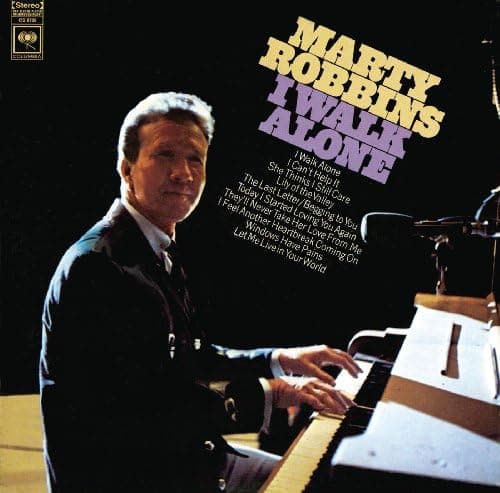
A Quiet Solitude Sung in Marty Robbins’s Deep Baritone
In “I Walk Alone,” Marty Robbins gave voice to a heartbreak so profound that it becomes a lonely pilgrimage—a country lament carried to No. 1 on the U.S. country singles chart in 1968, where it remained for two weeks and lingered for fifteen. The song was released on August 27, 1968, as the lead single and title track from his album I Walk Alone, produced by Bob Johnston on Columbia Records.
The Vinyl Archivist here, and what makes “I Walk Alone” so compelling is how it merges the weight of loss with the haunting calm of resignation. Written by Herbert W. Wilson, the tune was not originally Robbins’s: it saw earlier versions by artists like Eddy Arnold in the mid‑1940s. But it was Robbins — with his velvet baritone and understated, soulful delivery — who made it his own, turning a straightforward country ballad into a timeless meditation on solitude.
Lyrically, the song is spare but emotionally rich. Robbins sings of walking alone in places once shared: “I walk alone where once we wandered / It seems so strange that you are gone.” There is no bitterness, only a steady, unyielding faithfulness: “Until you return I’ll stay the same, dear / And I’ll still be true and walk alone.” The “flame of love” may still burn, but the narrator has become a solitary figure, unapologetically rooted in his loss.
Musically, the arrangement is elegant and restrained. The production by Bob Johnston opts for minimal ornamentation, allowing Robbins’s voice to carry the emotional weight without distraction. The melody is gentle, almost lullaby-like, yet its simplicity gives full space for the emotional tug of the lyrics. There’s an understated dignity in how Robbins approaches the song: he doesn’t plead, he doesn’t rage — he walks.
From a broader perspective, “I Walk Alone” sits within a period when Robbins was already established as a masterful storyteller: not just of gunfighter ballads like El Paso, but of more intimate, emotional terrain. His ability to inhabit different emotional landscapes—wild-west romance, existential solitude, unrequited love—is part of what made him such a formidable artist.
Culturally, the song resonated strongly. Its success (Robbins’s thirteenth country No. 1) paved the way for other country stars — Loretta Lynn, Kitty Wells, David Houston, Willie Nelson — to record their own versions in 1969. But none quite captured the particular mix of resignation and emotional gravity that Robbins brought to it.
In retrospect, “I Walk Alone” stands as one of Robbins’s most profound statements on loneliness — not the kind that demands rescue, but the kind that endures, quietly, with a stubborn loyalty to a memory. As the years pass and the world grows louder, returning to this song feels like stepping into a hushed chamber where every line echoes: even in solitude, love’s flame still burns.