
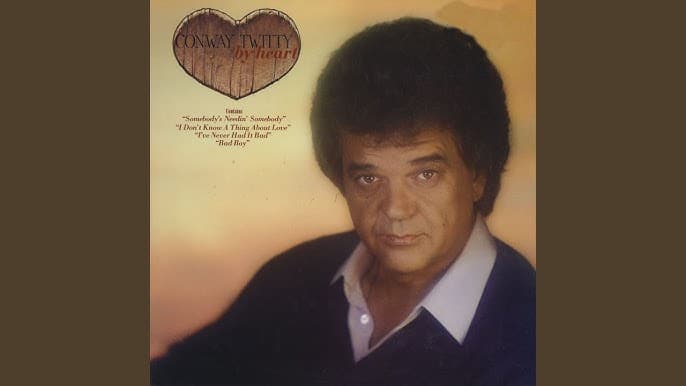
UP COMES THE BOTTLE DOWN GOES THE MAN encapsulates the tragic cycle of self‑destruction where the solace of the bottle becomes the undoing of a man’s dignity and dreams
Up Comes The Bottle Down Goes The Man is a poignant country narrative performed by Conway Twitty, released as a single in 1970. Though not among Twitty’s highest‑charting hits, the song stands as a vivid example of his ability to channel raw emotional truth through simple yet powerful storytelling in song. The track was paired with Fifteen Years Ago on its original 7‑inch single release and written by Twitty with collaborator L. E. White. Conway Twitty by this time was already well on his way to becoming one of country music’s most respected voices, ultimately achieving a record number of number one hits in his career.
In the opening lines of Up Comes The Bottle Down Goes The Man we are immediately drawn into a world familiar to the heartland and honky tonk alike: the repetitive descent of a man undone by his own reliance on drink. The refrain itself functions as both the song’s central metaphor and its tragic verdict. With each rising bottle, the man falls further away from his better self, losing not only control but perhaps all that once mattered to him. This thematic core reflects the realism that Twitty often embraced in his work, holding up for his audience a mirror to the less gilded facets of everyday life.
Musically, the arrangement is spare yet rooted in the classic country idiom of its time. The production, likely guided by the seasoned hand of Owen Bradley who worked frequently with Twitty during this era, places Twitty’s voice front and center. The emotional weight of the narrative is carried wholly by his baritone, which conveys both sympathy and weary resignation. Twitty’s phrasing in this song reveals his deep understanding of the genre’s narrative tradition: he does not merely sing the story he inhabits it.
While Up Comes The Bottle Down Goes The Man did not ascend to the commercial heights of Twitty’s signature hits like Hello Darlin or his numerous chart‑topping singles in the 1970s and 1980s, it nevertheless occupies a distinct place in his catalog as a study in character, consequence, and the quiet despair of repetition. In the broader context of Twitty’s work, the song reinforces his reputation for giving voice to the struggles of ordinary people, bringing empathy and nuance to themes that might otherwise lapse into stereotype.
Lyrically, the song captures a cycle that seems almost mythic in its repetition. The titular bottle is more than a prop; it is a force that reshapes the trajectory of a life. Each return to drink becomes a symbolic turning point where hope is lowered and loss is raised. The narrative sifts through moments of regret, self‑awareness, and the numbing comfort found in routine sorrow. In this sense, the song’s enduring resonance lies in its unflinching acknowledgment of human frailty and the solace that so often comes at terrible cost.
As listeners revisit Up Comes The Bottle Down Goes The Man, they are reminded that some of the most powerful country songs are those that trace the contours of ordinary heartbreak, illuminated by a performer whose voice can make those contours ring with universal truth.