
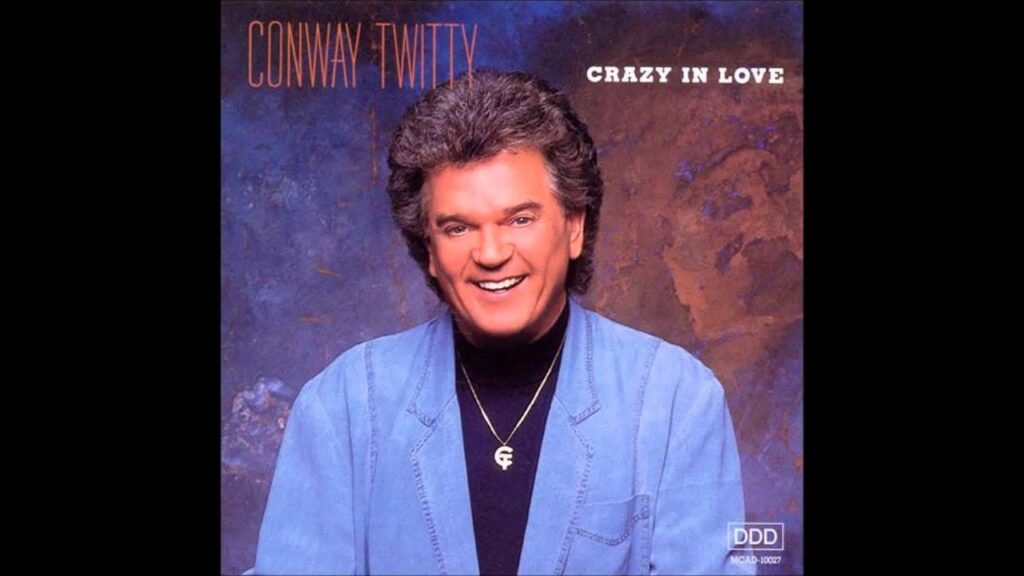
How Love’s Sweet Madness Became a Country Classic in the Sunset of a Legend
When Conway Twitty released his stirring rendition of “Crazy in Love” in August 1990 as the lead single from his album Crazy in Love (1990), it quickly reasserted his command over the emotional terrain of country music. The song climbed to number two on the Billboard Hot Country Singles & Tracks chart and earned the rare distinction of reaching number one on the Cashbox country charts, marking it as the last song of Twitty’s storied career to ascend a national top position.
In the grand catalogue of Conway Twitty, where heartbreak and devotion intertwine like vines in a Southern summer, “Crazy in Love” stands as a late-career apex of vulnerability and yearning. Twitty, born Harold Lloyd Jenkins, had navigated a remarkable arc from rockabilly breakthrough in the 1950s to becoming one of country music’s most beloved interpreters of love’s tumultuous soul. By 1990, decades of chart success and emotional balladry had honed his voice into an instrument of lived experience — weathered, smooth, and unafraid to dwell in the heart’s most volatile territories.
Written by Even Stevens and Randy McCormick, “Crazy in Love” was not originally a country composition. Its journey — first recorded by Joe Cocker in 1984 and later interpreted by artists like Kim Carnes and Kenny Rogers — testifies to a melody and lyric of universal resonance. Twitty’s version, however, transfigures it into something uniquely his own: a country confession that balances restraint and abandon, tradition and modernity.
At its core, the song is an elegy for the intoxicating, disorienting power of love — that state in which logic dissolves and one’s identity becomes indistinguishable from the beloved. Twitty’s vocal delivery is understated yet deeply expressive, embodying both the ache of memory and the ache of desire. Lines that might read as straightforward in print become charged under his gaze: simple phrases carry the weight of nights spent replaying lost moments, the subtle dynamism of his phrasing suggesting not just longing, but an intimate self-interrogation. He inhabits the lyrical narrator not as a performer, but as a confidant speaking directly to the listener’s own recollections of love’s beautifully destabilizing grip.
Musically, the arrangement reflects its era without abandoning Twitty’s roots. Gentle guitar lines and subtle background accents subtly recall the classic country ballad form, but there’s a pop sensibility in the song’s tempo and production that situates it comfortably in the late 20th-century country landscape. Rather than detracting from the song’s emotional impact, this blend of styles underscores a perennial truth: love, in all its permutations, transcends genre boundaries.
In the context of Twitty’s broader legacy, “Crazy in Love” is a poignant footnote — the last flame of flame-lit longing that flickered atop a career defined by nuance, warmth, and vulnerability. It is not merely a hit single, but an artistic testament to the enduring power of love’s madness — and to an artist who, even near the twilight of his journey, could articulate its depths with clarity and grace.