
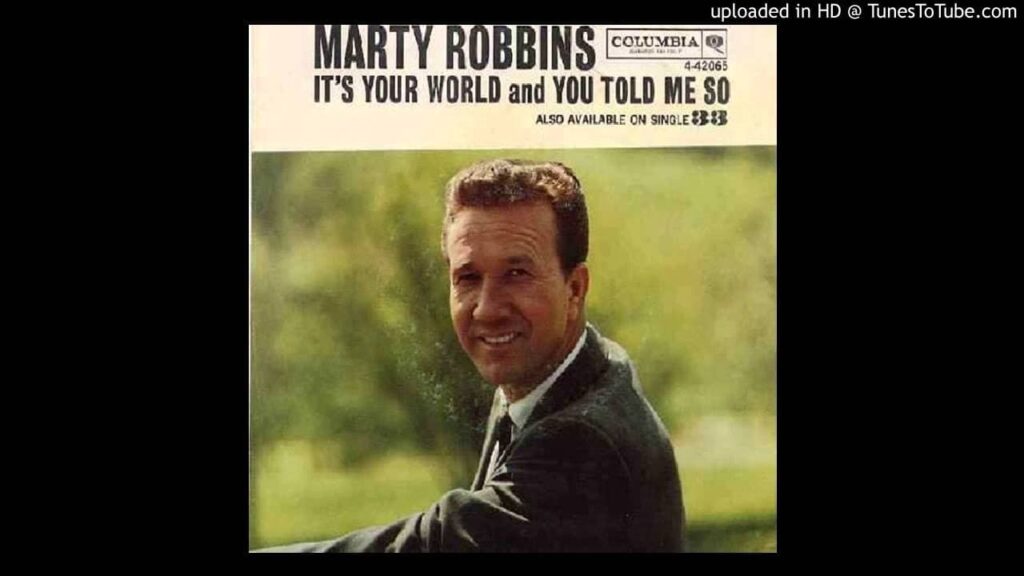
A Quiet Plea in a World That Turns Without You
“It’s Your World” by Marty Robbins is one of those crystalline moments in early 1960s country music where unvarnished vulnerability meets the craft of a master storyteller. Originally released in 1961 as a single, the song charted modestly, reaching number 51 on the US Billboard charts that autumn and holding a presence there for several weeks. Over time it has endured not because it was a blockbuster hit but because it distills the ache of unrequited devotion into a perfect, concise musical lament.
The track later appeared across compilations of Robbins’s early work, including the expansive anthology The Story of My Life: The Best of Marty Robbins 1952-1965, where it sits alongside many of his other reflective gems. To grasp the emotional purpose of “It’s Your World” one must consider its dual nature as both love song and elegy to expectation. Here Robbins sings not of conquest but of surrender, of a heart that yearns for acceptance in a realm that will not yield it.
At its core, the lyrics portray a speaker who perceives himself as an interloper, passing through the radiance of another’s life. “It’s your world and your smile turns on my sunshine,” Robbins sings, a line that illustrates how love for another can feel less like mutual illumination and more like standing in the shadow of someone’s light. The narrator’s desire to “live in your world” is simultaneously poignant and somber because he acknowledges his exclusion from it. This is not the bold swagger of a conqueror of hearts. It is the quiet, aching desire of someone who recognizes that their longing is unreciprocated.
Musically the song reflects the era’s leaner production aesthetics. Robbins’s delivery is direct and unadorned, his voice holding a steady lament that supports rather than overwhelms the sentiment. The arrangement lets the simple melody and the sincerity of his voice carry the emotional weight. That transparency is the song’s strength. The sparseness allows listeners to project their own memories of longing and unfulfilled love onto the performance.
It is worth noting that Robbins, better known for expansive narrative country epics like “El Paso” and the bold rhythms of “Devil Woman,” brings a different sort of narrative craft to “It’s Your World.” Here he compresses a complex emotional journey into a lyrical statement that is deceptively simple. Every repetition, every turn of phrase underscores how effortless it can be for the heart to give its power away, to make another person’s indifference seem like the central force in one’s own life.
Over the decades, “It’s Your World” has come to represent the quieter side of Robbins’s artistry. It is an intimate, introspective piece, a song less about spectacle and more about the shared human experience of yearning for something just beyond reach. Its legacy is not one of massive commercial success but of emotional resonance. It is a reminder that in country music, as in life, the most powerful stories are often those told in hushed voices.