
A Love So Enduring It Rose Like a Hill Above the Noise of Its Time
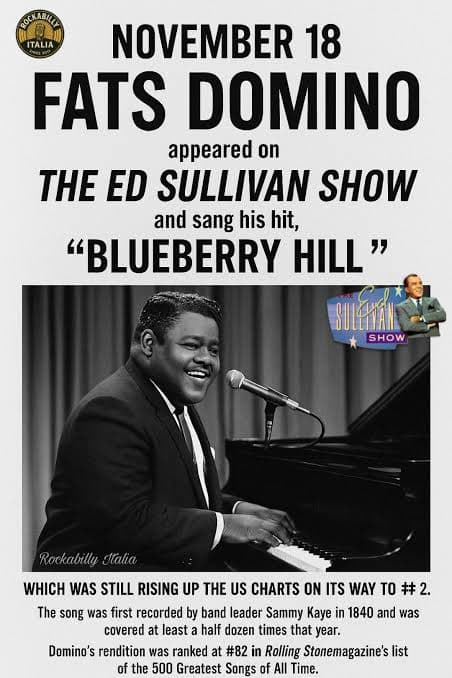
When Fats Domino carried “Blueberry Hill” onto national television on The Ed Sullivan Show, he was no longer merely a rhythm-and-blues star from New Orleans. He was the genial architect of a crossover moment that had already reshaped American popular music. Released in 1956 on the album This Is Fats Domino!, the single became his signature triumph, spending eleven weeks at No. 1 on the Billboard R&B chart and climbing to No. 2 on the pop chart. Those numbers told one story. The performance told another: a quiet revolution dressed in a smile.
By the time he sat at the piano under Sullivan’s bright studio lights, Fats Domino had refined a style that felt both intimate and unstoppable. His rolling triplet piano figures, drawn from the barrelhouses of New Orleans, carried a lilt that softened the edges of early rock and roll. “Blueberry Hill” itself was not new; it had first been recorded in 1940 by big-band and swing vocalists. Yet Domino’s 1956 interpretation did something extraordinary. He slowed the tempo, deepened the groove, and infused the melody with a warmth that felt less like nostalgia and more like memory rediscovered.
The lyrics are deceptively simple. “I found my thrill on Blueberry Hill.” It is a line that reads like a diary entry rather than a declaration. There is no elaborate metaphor, no ornate poetry. The hill is both literal and symbolic, a place where love was first felt and later lost. In Domino’s hands, the song becomes a meditation on the permanence of feeling even when circumstances shift. The thrill remains suspended in time, even as the beloved moves on. This emotional duality, joy remembered and sorrow endured, is what gave the performance its gravity.
On The Ed Sullivan Show, a program that functioned as America’s cultural living room, Domino’s genial presence disarmed a nation still negotiating its anxieties about rock and roll. There were no theatrics, no rebellious sneer. Just a man at a piano, rocking gently, letting the melody speak. The camera lingered on his hands, then on his face, as if recognizing that the revolution did not always arrive with thunder. Sometimes it arrived with a tender refrain.
What lingers from that televised moment is not merely the chart success or the historical milestone. It is the sense that “Blueberry Hill” became a bridge. Between R&B and pop. Between Black New Orleans and mainstream America. Between the ache of lost love and the resilience of memory. In its gentle sway, one hears the early heartbeat of rock and roll finding its romantic soul.