
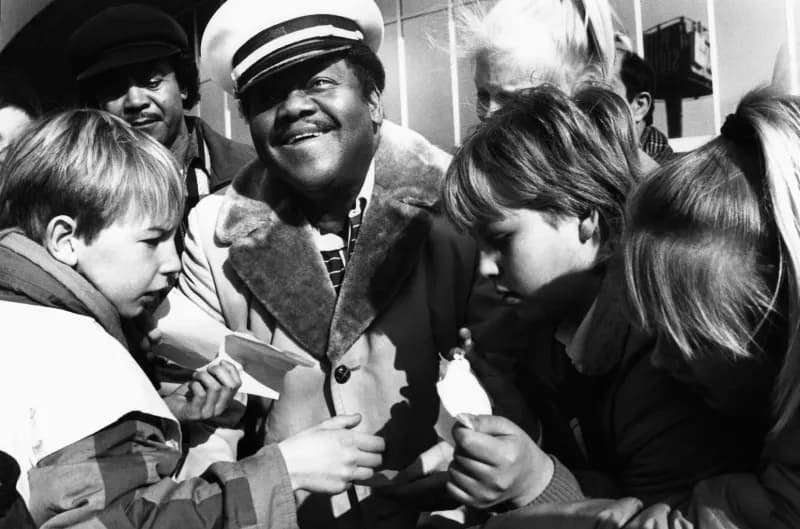
A night when joy tipped into chaos, revealing how irresistible rhythm could unsettle a divided America.
In 1957, at the height of Fats Domino’s commercial dominance, the music that fueled his ascent up the charts collided with the social pressure of the moment during what has come to be remembered as The violent performance in San Jose (1957). This was not a song pressed to vinyl or issued from an album sleeve, but a live eruption that unfolded while Domino was riding a remarkable run of hits that regularly placed him near the summit of the R&B charts and firmly within the pop Top 10. His records from this period, issued by Imperial Records and anchored by albums like This Is Fats Domino!, had already established him as one of the most reliable hitmakers of the rock and roll era, an artist whose warm piano triplets and genial voice crossed racial and generational lines with unprecedented ease.
What happened in San Jose cannot be separated from that context. By 1957, Domino’s music was no longer confined to jukeboxes in Black neighborhoods or late night radio slots. Teenagers, white and Black alike, responded to his rolling rhythms with an intensity that promoters and civic authorities were unprepared to manage. The San Jose performance became violent not because Domino courted chaos, but because his music unlocked something volatile. Fans surged forward, barriers failed, and the energy of a Domino show, usually joyful and communal, tipped into disorder. The incident echoed similar disturbances at rock and roll concerts across the United States, where the sight of young bodies moving freely to Black music unsettled older norms of control and segregation.
From a musical standpoint, the irony is striking. Fats Domino was never a provocateur in image or intent. His songs favored humility, romance, and everyday resilience. The left hand of his piano walked patiently, the right hand shimmered with New Orleans bounce, and his voice radiated reassurance rather than rebellion. Yet that very warmth made the music accessible, and accessibility made it powerful. In San Jose, the crowd’s reaction testified to how deeply Domino’s sound had penetrated the American psyche. Rock and roll was no longer an abstraction; it was a physical force capable of overwhelming halls and rewriting behavioral codes.
Culturally, the San Jose incident stands as a lens through which to view the contradictions of the 1950s. Domino, a Black artist from New Orleans, stood at center stage while predominantly white audiences lost control to rhythms rooted in Black experience. The violence that followed was less about the man at the piano than about a society struggling to reconcile integration, youth autonomy, and the sudden democratization of pleasure through music. Domino himself reportedly remained characteristically calm, embodying a dignity that contrasted sharply with the surrounding turmoil.
Today, The violent performance in San Jose (1957) survives as a footnote in biographies and histories of early rock and roll, yet its resonance endures. It reminds us that the most gentle artists can preside over the most seismic cultural shifts. In the grooves of Fats Domino’s records lies joy, but also the spark that made audiences feel alive enough to forget the rules. That night in San Jose, the archive tells us, was the sound of America realizing that rock and roll was not just to be heard. It was to be felt, sometimes more intensely than anyone was ready for.