
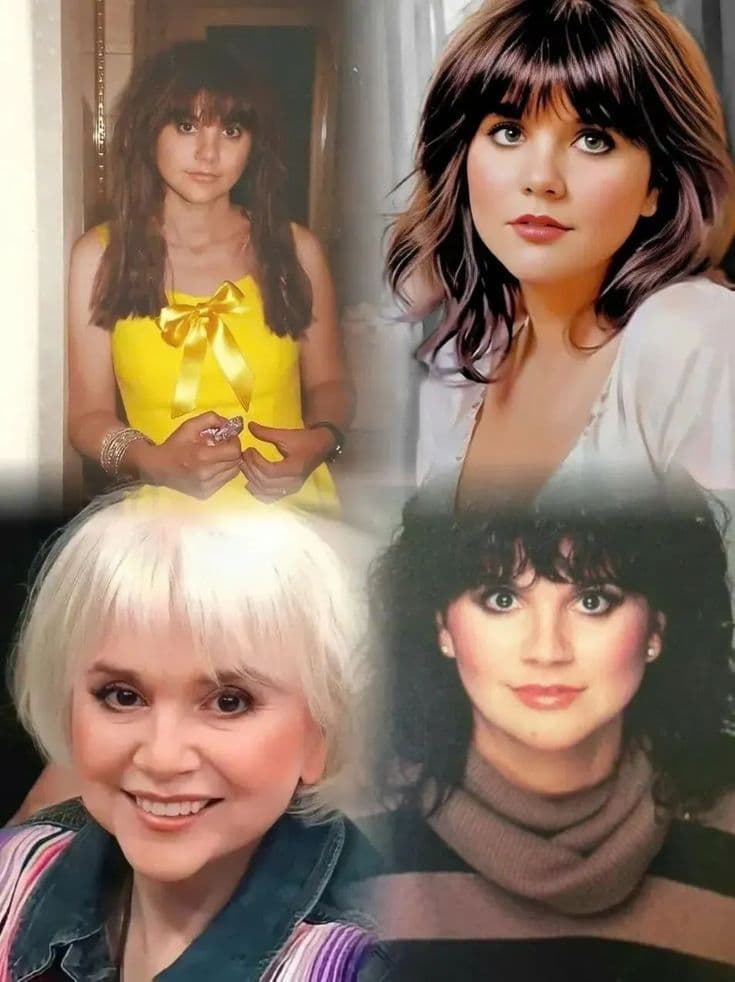
Farewell Delivered with a Smile That Cannot Conceal the Hurt
When Linda Ronstadt released her rendition of “It Doesn’t Matter Anymore” on the 1974 album Heart Like a Wheel, she was in the midst of a commercial ascent that would define the decade. The album itself soared to No. 1 on the Billboard 200 and became a multi-platinum landmark, anchoring Ronstadt as one of the most commanding vocalists of the 1970s. Though not issued as a primary single from the record, her interpretation of the song stood as a quiet pillar within an album that also produced the No. 1 hit “You’re No Good.” In this context, “It Doesn’t Matter Anymore” becomes something more than a cover. It becomes a statement of emotional authority.
The song was originally written by Paul Anka and immortalized by Buddy Holly in 1959, its breezy shuffle rhythm disguising a bruised heart beneath. Holly sang it with a characteristic lilt, almost defiant in its lightness. Ronstadt approaches it differently. Where Holly’s version feels like a young man trying to shrug off heartbreak with bravado, Ronstadt’s reading is steeped in adult resignation. She does not pretend indifference. She exposes the cost of it.
Her phrasing is deliberate, almost conversational at first. The opening lines drift in with a calm that feels rehearsed, the voice of someone who has repeated the words in the mirror, trying to believe them. But as the song unfolds, subtle cracks appear. Ronstadt had an extraordinary ability to stretch a vowel just enough to suggest the tremor beneath composure. It is in those elongated syllables that the song reveals its true thesis: indifference is often the final stage of sorrow, not its absence.
The arrangement on Heart Like a Wheel leans into a gentle country-rock texture, aligning with the album’s broader fusion of rock sensibility and Nashville craftsmanship. The steel guitar sighs in the background, an instrument historically tied to longing, while the rhythm section maintains a restrained pulse. Nothing overwhelms the vocal. It cannot. Ronstadt’s voice is the axis around which the entire performance turns.
What makes her interpretation enduring is the tension between lyric and delivery. The refrain insists, almost stubbornly, that the relationship’s end carries no consequence. Yet every tonal inflection contradicts that claim. This duality mirrors the emotional paradox of separation. We tell ourselves it no longer matters precisely because it once mattered so deeply.
Within the broader arc of Ronstadt’s career, “It Doesn’t Matter Anymore” demonstrates her gift for reclamation. She did not merely revive songs from earlier eras. She reframed them. In her hands, a late-1950s pop lament becomes a 1970s meditation on dignity and self-possession. The ache remains, but so does the strength.
And that is why the song lingers. It is not a declaration of apathy. It is a portrait of survival.