
A quiet confession of devotion that turns everyday love into something timeless
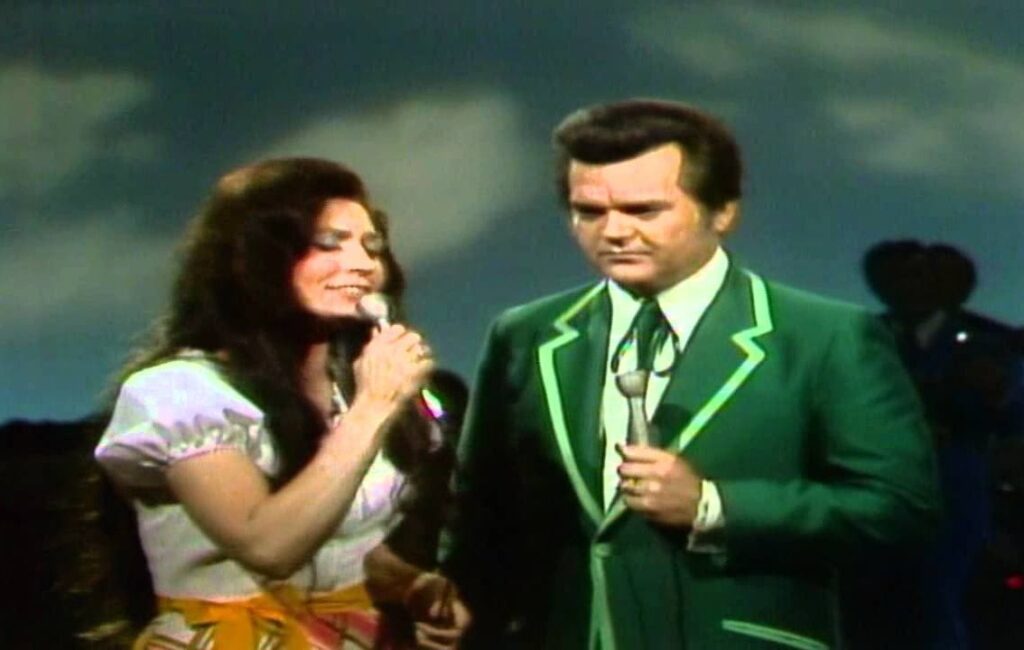
Few recordings in classic country music capture tenderness as sincerely as Easy Loving, the signature composition of Freddie Hart, first immortalized by Hart in 1971 and later embraced by many voices across Nashville. When Conway Twitty and Loretta Lynn brought their own interpretation of Easy Loving to audiences, they were already among the most beloved duet partners in country history. Their rendition drew on the deep musical chemistry that had defined albums such as Louisiana Woman, Mississippi Man, transforming the song’s gentle sentiment into a shared conversation between two seasoned storytellers of the genre.
The song itself had already proven its extraordinary power when Freddie Hart released Easy Loving on his album Easy Loving, a recording that rose to No. 1 on the Billboard Hot Country Singles chart and remained there for three weeks, eventually becoming one of the defining country hits of the early 1970s. It also earned Hart the Country Music Association’s Song of the Year award, an honor repeated the following year. By the time Conway Twitty and Loretta Lynn performed it together, Easy Loving had become something more than a hit. It had become a standard, a quiet anthem of devotion that artists returned to whenever they wished to express the simplest and most powerful emotion in country music: gratitude for love that endures.
In the hands of Conway Twitty, the song takes on a particularly warm resonance. Twitty’s voice, smooth yet grounded, had long been capable of conveying longing with almost conversational intimacy. When paired with Loretta Lynn, whose phrasing carried both steel and vulnerability, the song becomes less of a solitary declaration and more of a shared truth between two lives intertwined.
The lyrics themselves are striking in their simplicity. There are no elaborate metaphors, no dramatic heartbreaks or grand gestures. Instead, Easy Loving rests on a profound realization: that love, when genuine, feels effortless. The narrator does not describe passion in fiery language. Instead, he marvels at the quiet miracle of waking each day beside someone who makes the ordinary feel extraordinary. In country music, where tales of heartbreak often dominate the landscape, such gratitude feels almost radical in its sincerity.
Musically, the arrangement supports this emotional clarity. The gentle rhythm, warm steel guitar, and restrained orchestration allow the voices to remain at the center of the performance. In a duet setting, the lines pass between Conway Twitty and Loretta Lynn like reflections in a mirror. Each voice confirms the other’s feeling, creating the impression that the love described in the song truly belongs to both singers.
What makes Easy Loving endure decades after its creation is precisely this lack of complication. It speaks to the quiet victories of everyday affection, the steady companionship that grows stronger through time rather than spectacle. In the voices of Conway Twitty and Loretta Lynn, two artists whose careers were built on portraying love in all its complexities, the song becomes a moment of calm after many storms.
Within the vast library of country duets, Easy Loving stands as a reminder that sometimes the most powerful emotion is the one spoken softly. When two voices like these meet within a song so gently written, the result is not merely a performance. It becomes a portrait of love that feels lived in, patient, and beautifully real.