
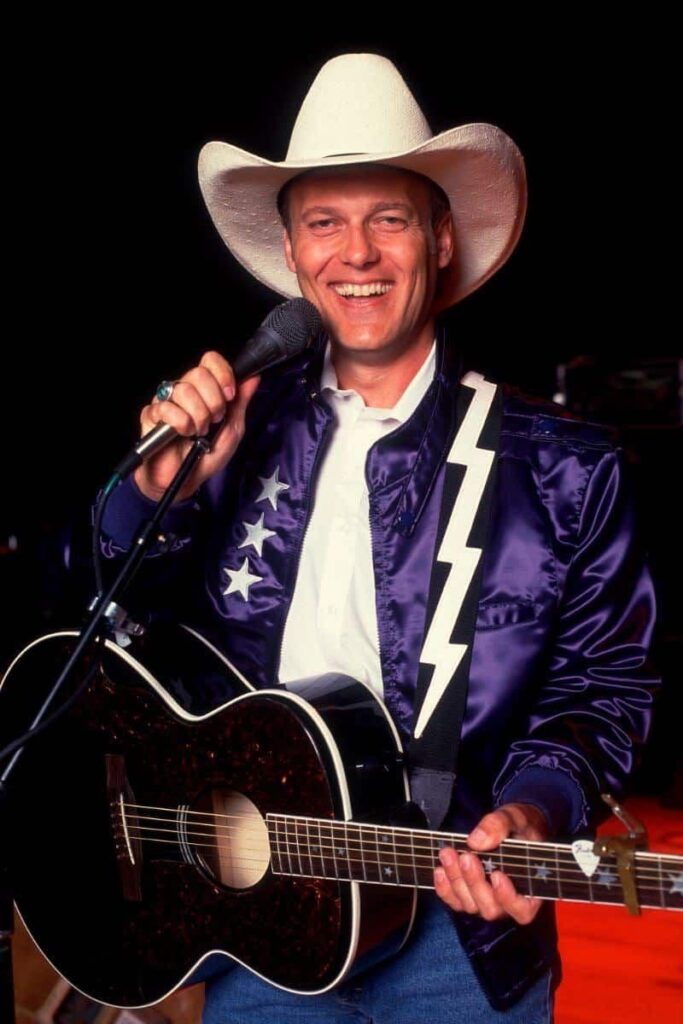
A wounded soul refusing comfort, knowing that some heartbreaks demand solitude rather than salvation
When Ricky Van Shelton released Don’t Send Me No Angels as part of his 1988 album Wild-Eyed Dream, he was in the midst of a remarkable ascent in country music, a period defined by a string of chart-topping successes on the Billboard Hot Country Songs chart. The album itself produced multiple No. 1 hits, establishing Shelton as one of the most commanding traditionalist voices of his generation. Within that context, Don’t Send Me No Angels stands not as a commercial centerpiece, but as something arguably more enduring, a quiet, introspective confession that reveals the emotional architecture beneath the polished surface of his success.
The song unfolds with a striking premise. Rather than pleading for healing or redemption, the narrator resists it. The phrase “don’t send me no angels” carries a paradoxical weight, suggesting a man so deeply entrenched in heartbreak that even the idea of rescue feels intrusive. This is not the dramatic anguish of a shattered lover crying out for relief. It is something far more restrained, and perhaps more devastating. It is the acceptance of pain as a necessary companion, a refusal to dilute the authenticity of loss with premature consolation.
Ricky Van Shelton was often celebrated for his ability to channel the lineage of classic country voices, echoing the emotional directness of artists like Lefty Frizzell and Merle Haggard. In Don’t Send Me No Angels, that lineage becomes especially apparent. His vocal delivery is measured, almost conversational, yet every note is weighted with intention. There is no excess ornamentation, no attempt to dramatize the sorrow. Instead, Shelton allows the silence between phrases to speak, creating a sense of intimacy that draws the listener inward.
Musically, the arrangement remains faithful to the neotraditionalist movement that defined late 1980s country. Steel guitar lines drift through the composition like distant memories, while the rhythm section maintains a steady, unhurried pulse. This restraint is crucial. It mirrors the emotional state of the narrator, who is not spiraling outward but turning inward, processing grief in a private, almost sacred space.
What makes Don’t Send Me No Angels particularly resonant is its philosophical undercurrent. It challenges a common narrative within love songs, the idea that pain must always be resolved, that heartbreak must inevitably lead to healing. Here, Shelton presents an alternative perspective. Sometimes, the truest expression of love lost is not the search for closure, but the willingness to sit with the absence it leaves behind.
In the broader arc of Ricky Van Shelton’s career, the song serves as a reminder of his depth as an interpreter of emotion. Beyond the chart-topping singles and radio staples, there exists this quieter body of work, songs that do not seek immediate acclaim but instead linger, revealing their full weight over time. Don’t Send Me No Angels belongs firmly in that category.
It remains a testament to the power of understatement in country music, where a single line, delivered with sincerity, can carry the emotional gravity of an entire life.