
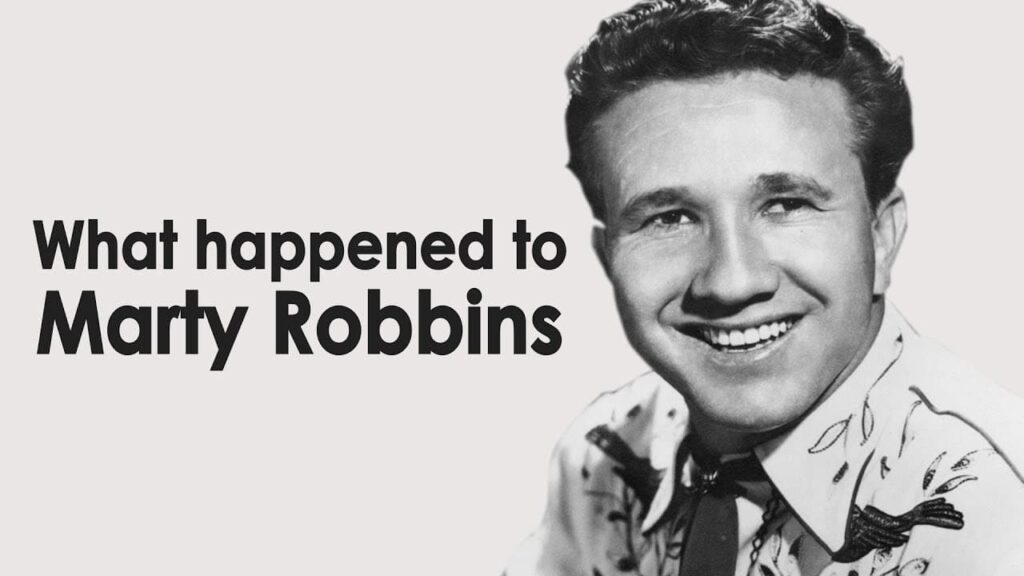
A Voice That Rode Across America Until Silence Became Part of the Legend
By the time the question “What happened to Marty Robbins?” began circulating among country audiences in the early 1980s, the answer already carried the weight of a disappearing era. Few artists in American music history had traveled as widely across emotional and stylistic terrain as Marty Robbins, the Arizona-born singer whose career stretched from western ballads and honky-tonk confessionals to pop crossover success. His landmark 1959 album Gunfighter Ballads and Trail Songs transformed him from a respected country performer into a cultural institution, driven largely by the astonishing success of “El Paso,” which reached No. 1 on both the country and pop charts and later earned a Grammy Award. Yet the question surrounding Robbins was never simply about fame fading. It was about the gradual dimming of one of country music’s most distinctive storytellers.
What happened to Marty Robbins was not a sudden collapse, nor a scandal, nor a dramatic disappearance from public life. It was the slow physical decline of a man who continued performing long after his body had begun to fail him. Throughout the late 1970s and early 1980s, Robbins battled severe cardiovascular disease. He underwent multiple heart surgeries, including a quadruple bypass operation, yet refused to detach himself from the stage for very long. There was something deeply characteristic in that refusal. Robbins belonged to a generation of performers who viewed music not as a career strategy but as identity itself. To stop singing would have meant surrendering the very thing that gave his life structure.
What makes Robbins endure is not merely the success of records like “El Paso,” “Big Iron,” “Don’t Worry,” or “My Woman, My Woman, My Wife.” It is the peculiar loneliness embedded within them. Even at his commercial peak, his recordings carried an air of distance, as though the narrator already understood that every triumph eventually fades into memory. His voice had remarkable clarity, but beneath that smooth control lived a quiet ache. Robbins sang like a man standing slightly outside the room, observing heartbreak, violence, redemption, and regret with painful calm.
That emotional restraint became especially powerful in his western ballads. Songs such as “Big Iron” were cinematic long before country music regularly embraced cinematic scale. Robbins painted deserts, saloons, fugitives, and doomed lovers with such precision that listeners could practically feel the dry wind moving through the speakers. Yet the violence in his songs was rarely about spectacle. It was about consequence. Men died alone. Heroes carried guilt. Love almost always arrived too late.
As country music moved into the slicker commercial landscape of the late 1970s, Robbins increasingly seemed like the guardian of an older emotional language. He remained respected, but the industry around him changed rapidly. Younger audiences gravitated toward newer production styles, while Robbins continued carrying the spirit of mid-century country storytelling. Even so, he never became obsolete. If anything, age gave his performances additional gravity. The songs sounded lived-in. Every line carried history.
On December 8, 1982, shortly after undergoing yet another surgery, Marty Robbins died at the age of 57. For many fans, the loss felt larger than the death of a singer. It felt like the closing of a frontier in American music itself. Robbins had embodied a version of country music where storytelling still mattered more than image, where emotional honesty outweighed fashion, and where songs unfolded like weathered novels compressed into three minutes.
The question “What happened to Marty Robbins?” therefore has two answers. Physically, his heart gave out after years of relentless strain. Artistically, however, very little happened at all. His records never truly left. They remain preserved in jukeboxes, dusty vinyl collections, late-night radio broadcasts, and the memories of listeners who still recognize that unmistakable voice riding through the darkness like a lone traveler refusing to disappear.