
Desire, mystery, and the fleeting courage to reach for love in a passing moment
When Roy Orbison released Oh, Pretty Woman in 1964, it quickly ascended to the top of the charts, reaching No. 1 on the Billboard Hot 100 and becoming one of the defining singles of his career. Issued as a standalone single rather than part of a contemporary album cycle, the song nevertheless stands as a cornerstone within Orbison’s broader catalog, later appearing on compilations such as The Very Best of Roy Orbison. By the time he performed it on American Bandstand in 1966, the song had already secured its place in popular music history, yet its live presentation revealed new dimensions of its enduring allure.
At first glance, Oh, Pretty Woman seems deceptively simple. Its now-iconic opening guitar riff announces itself with a confidence that borders on swagger, a rare tonal shift for an artist more often associated with operatic sorrow and romantic tragedy. Yet within that rhythmic pulse lies a carefully constructed tension. Orbison, known for his extraordinary vocal range and emotional vulnerability, steps into a more grounded, almost conversational register. The effect is striking. Instead of lamenting lost love, he is caught in the immediacy of desire, watching a woman pass by and summoning the nerve to call out to her.
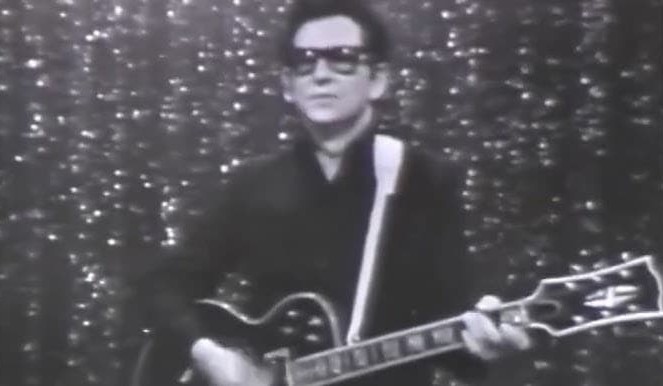
The performance on American Bandstand underscores this transformation. Here is Roy Orbison, clad in his signature dark attire and sunglasses, standing almost motionless, allowing the music to carry the narrative. There is no theatrical excess, no exaggerated gesture. His restraint becomes the performance’s defining strength. Each line is delivered with precision, the phrasing controlled yet charged with an undercurrent of longing. The audience witnesses not just a song, but a moment suspended in time, where anticipation outweighs certainty.
Lyrically, the song captures a universal experience. The fleeting encounter. The silent admiration. The internal debate between hesitation and action. When Orbison sings, there is both admiration and doubt woven into his voice. The woman is idealized, almost mythic, yet the singer remains grounded in human vulnerability. This duality is what elevates Oh, Pretty Woman beyond a simple rock-and-roll narrative. It becomes a meditation on courage, however brief, in the face of desire.
Musically, the track’s structure reinforces this emotional arc. The steady beat drives forward like footsteps on a city street, while the guitar riff acts as both invitation and insistence. Then comes the unexpected shift in the middle section, where the tempo softens and Orbison’s voice momentarily drifts into uncertainty. It is a pause that reveals the fragile interior beneath the confident exterior. When the rhythm returns, it feels less like triumph and more like acceptance of the moment’s ephemeral nature.
In the broader context of the 1960s, a period marked by rapid cultural change and evolving musical identities, Roy Orbison carved out a unique space. He was neither fully aligned with the raw rebellion of rock nor confined to the sentimentality of traditional pop. Oh, Pretty Woman, especially in its 1966 televised performance, embodies that balance. It is both immediate and timeless, grounded and dreamlike.
Even now, decades removed from that stage, the song endures because it captures something irreducibly human. The courage to speak, the fear of rejection, and the quiet understanding that some moments, no matter how vivid, are destined to pass.