
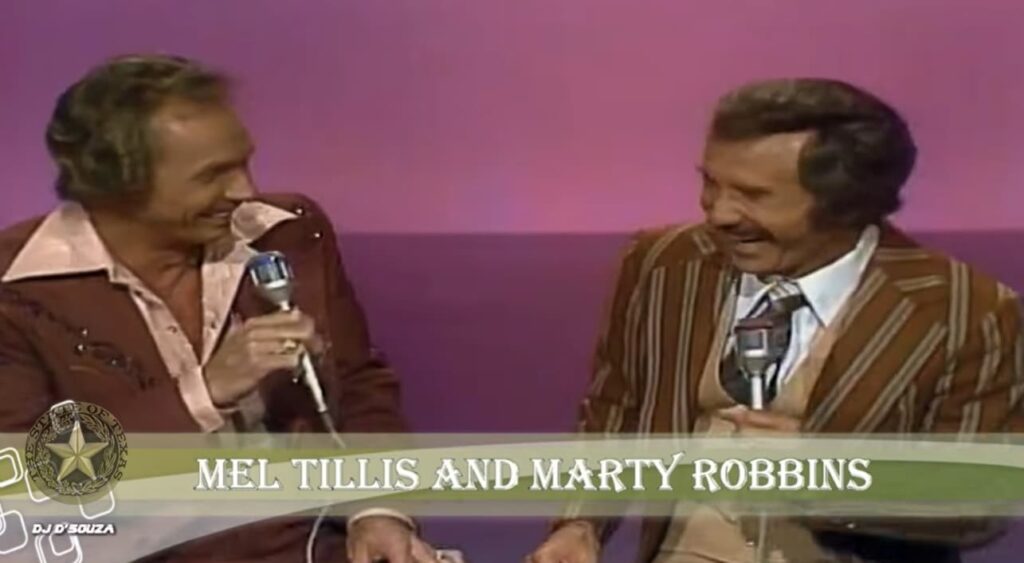
When Two Country Troubadours Shared a Stage, the Silence Between the Notes Told the Real Story
There are performances that survive because they were technically flawless, and then there are performances that endure because they captured the spirit of country music before polish replaced personality. The appearance of Mel Tillis alongside Marty Robbins on the Marty Robbins Show belongs firmly to the latter category. By the time these two men stood together under television lights, both were already deeply woven into the fabric of American country music. Robbins had long established himself through landmark recordings like “El Paso”, a song that reached No. 1 on the Billboard Hot 100 and became the centerpiece of his landmark album Gunfighter Ballads and Trail Songs, while Tillis was steadily becoming one of Nashville’s most respected songwriters and entertainers, eventually building a catalog filled with enduring country standards.
What makes footage like this resonate decades later is not spectacle. It is familiarity. The atmosphere feels less like a television production and more like a gathering of traveling musicians who had spent years inside smoke-filled auditoriums, backstage dressing rooms, and late-night radio barns. Marty Robbins carried himself with remarkable calmness on camera. There was never any need for him to dominate a room. His voice already did that. Smooth but lonely, polished yet haunted, Robbins sang with the kind of controlled melancholy that became one of the defining sounds of post-war country music.
Mel Tillis brought something entirely different. Offstage, his famous stutter made him seem approachable, almost vulnerable. But once music began, the hesitation vanished completely. That transformation became one of the most quietly inspiring aspects of his career. Audiences did not simply admire Tillis because he could write hits or command a stage. They admired him because he represented resilience without self-pity.
Watching the two together now feels like witnessing two separate branches of country music meet in the middle. Robbins represented the cinematic side of the genre, the desert ballads, the wandering cowboys, the emotional fatalism. Tillis represented its conversational heart, the humor, humility, and everyday humanity that kept country music grounded even as Nashville evolved into a larger commercial machine.
The beauty of these old television performances is that nothing was rushed. Modern audiences, conditioned by rapid editing and constant visual stimulation, sometimes forget how powerful stillness can be. On programs like this, songs were allowed to breathe. Cameras lingered on expressions. Musicians listened to each other. Every pause mattered. That patience created intimacy.
There is also something deeply symbolic about seeing artists like Robbins and Tillis together during country music’s transitional decades. They came from an era when performers were expected to survive every format imaginable: radio, dance halls, package tours, television variety shows, and relentless touring schedules across small American towns. They were not manufactured personalities. They were road-tested storytellers.
And perhaps that is why clips from the Marty Robbins Show continue circulating among devoted country fans long after the original broadcasts faded from television schedules. They preserve a version of country music untouched by irony. No calculated nostalgia. No reinvention. Just two seasoned artists standing side by side, singing songs that understood loneliness, pride, humor, heartbreak, and endurance with uncommon honesty.
In the end, performances like this remind us that classic country music was never only about the songs themselves. It was about presence. The quiet dignity of men who carried entire lifetimes into a single verse.