
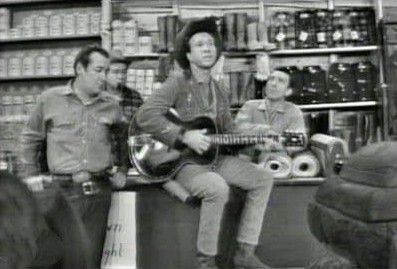
A Ballad Where Love and Death Rode Side by Side Across the Texas Dust
When Marty Robbins carried “El Paso” onto the stage in his live performances throughout the 1960s and 1970s, he was not merely revisiting a hit record. He was reopening one of country music’s most cinematic tragedies. Originally released in 1959 on the album Gunfighter Ballads and Trail Songs, the song became a phenomenon, reaching No. 1 on the Billboard Hot 100 and later earning a Grammy Award. Few western ballads had ever crossed so completely into the American mainstream. Fewer still managed to preserve such haunting intimacy while doing so. In concert, however, “El Paso” became something even larger than the studio recording: a living frontier myth carried by Robbins’ unmistakable voice, calm and mournful like a man recounting memories he wished he could forget.
The brilliance of the song lies in how deceptively simple its structure appears. On paper, it is the oldest story imaginable. A cowboy falls in love, kills out of jealousy, flees justice, and ultimately rides back toward death because separation from the woman he loves becomes unbearable. Yet Robbins transformed that familiar framework into something operatic. His storytelling moved with the precision of film editing. Every verse revealed another visual detail: the cantina lights, the New Mexico badlands, the black horse running through the night, the desperate final return to Rosa’s arms. By the time the final lines arrive, the listener is no longer hearing a country song. They are witnessing the collapse of a man’s entire emotional world.
Live performances intensified that effect. Robbins understood pacing in a way few vocalists of his era truly mastered. He never rushed “El Paso.” He allowed silence to breathe between phrases, letting the audience absorb the fatalism hanging over every lyric. The audience already knew the ending, yet the suspense remained intact because Robbins sang not like a narrator reading a script, but like a man still trapped inside the memory. That distinction mattered. Many singers perform stories. Robbins inhabited them.
Part of the enduring power of “El Paso” also comes from its moral ambiguity. The protagonist is neither hero nor villain. He commits murder, yet Robbins never frames him as monstrous. Instead, the song explores obsession, regret, pride, and surrender with remarkable emotional maturity. The cowboy understands that returning to El Paso means death, but loneliness has already become its own form of dying. That emotional logic gives the ballad its devastating gravity. The final ride back is not reckless bravado. It is emotional inevitability.
Musically, the song occupies a fascinating space between Nashville craftsmanship and Hollywood western atmosphere. The Spanish guitar flourishes, the rolling rhythm, and the spacious arrangement created a sonic landscape that felt genuinely geographical. One could almost feel the desert wind moving through the recording. Robbins’ phrasing floated above it with extraordinary restraint. He never over-sang the tragedy. That restraint is precisely why the song still cuts so deeply decades later.
In the history of American popular music, “El Paso” remains one of the rare crossover masterpieces that never sacrificed narrative sophistication for commercial success. Live, it became even more revealing. You could hear an audience fall silent before the final verse because everyone understood what was coming, yet no one wanted the ride to end. That is the mark of a true ballad classic: not merely a song remembered, but a world listeners willingly return to, knowing heartbreak waits at the end of the trail.