
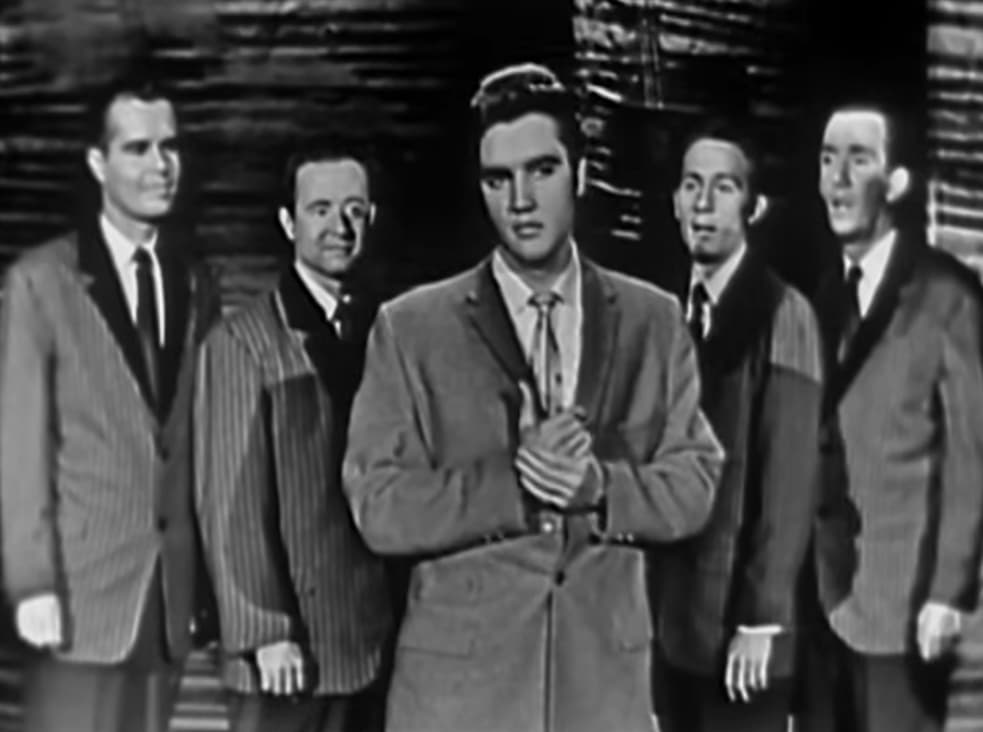
A plea for devotion becomes one of Elvis Presley’s most intimate early triumphs.
When Elvis Presley stepped onto the stage of The Ed Sullivan Show to perform “Love Me,” he was no longer merely a rising rock-and-roll sensation—he was becoming a cultural force. Originally featured on Elvis (1956), his second studio album, the song grew into one of the standout recordings of that remarkable year. Released through the Elvis, Volume 1 EP, “Love Me” climbed to No. 2 on the U.S. pop chart, while also reaching No. 10 on the country chart and No. 7 on the R&B chart, a testament to Presley’s rare ability to transcend musical boundaries. Written by the legendary songwriting team of Jerry Leiber and Mike Stoller, the song arrived during a period when Elvis seemed incapable of escaping the spotlight, yet its emotional core feels surprisingly vulnerable.
Unlike the swagger of “Hound Dog” or the youthful rebellion that often defined Elvis’s early image, “Love Me” reveals another side of the singer—one rooted in longing rather than confidence. The lyrics are striking in their simplicity. There is no grand declaration, no dramatic narrative, only a heartfelt plea. The narrator asks for affection even under imperfect circumstances, creating a portrait of devotion that borders on self-sacrifice. In lesser hands, such sentiments might seem sentimental. In Elvis’s voice, they become deeply human.
What makes the performance endure is the tension between strength and fragility. Elvis sings with the authority of a star who has already conquered the charts, yet he delivers each line as though he fears the answer may still be no. That contradiction lies at the heart of the song’s emotional power. It speaks to a universal truth: love often leaves even the strongest among us exposed.
The television performances, particularly on The Ed Sullivan Show, amplified that emotional connection. Millions of viewers who had first encountered Elvis as a symbol of youthful energy suddenly saw an artist capable of tenderness and restraint. His phrasing slows time. The pauses feel deliberate, almost conversational. Rather than overwhelming the listener with vocal acrobatics, he leans into sincerity, allowing the melody to carry the weight of the emotion.
Musically, “Love Me” occupies an important place in Elvis’s catalog. It demonstrated that his appeal was not limited to rock-and-roll excitement. He could inhabit a ballad with equal conviction, foreshadowing the emotional depth that would later define classics such as “Are You Lonesome Tonight?” and “Can’t Help Falling in Love.” The recording helped broaden public perception of Presley, proving that beneath the headlines and hysteria was a singer with an instinctive understanding of vulnerability.
Seventy years later, “Love Me” remains one of the finest examples of early Elvis at his most emotionally direct. It is not merely a love song—it is a reminder that the most enduring performances are often the quietest ones. In a decade obsessed with youthful confidence, Elvis dared to sing about emotional dependence, and in doing so, created a moment that still resonates long after the applause has faded.