
A simple invitation becomes a profound promise of belonging, where loneliness yields to the healing power of unconditional acceptance.
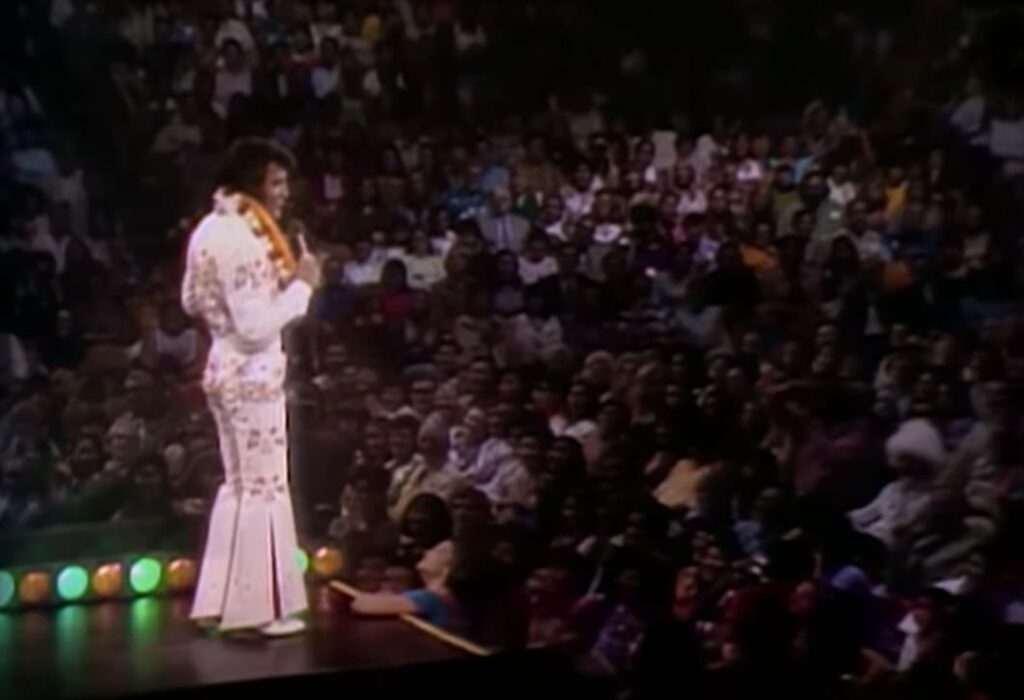
When Elvis Presley performed “Welcome To My World” during the historic Aloha from Hawaii via Satellite concert in Honolulu in 1973, he transformed an already beloved country-pop standard into one of the evening’s most intimate moments. Featured on the landmark live album Aloha from Hawaii: Via Satellite, the performance became part of one of the most commercially successful concert releases of Elvis’s career. While this particular live rendition was not issued as a standalone chart single, it gained enduring recognition through the extraordinary global reach of the broadcast and the enduring popularity of the album itself. In the context of a concert remembered for its international scale and cultural significance, Elvis Presley demonstrated that his greatest strength was not merely commanding vast audiences, but making each listener feel personally welcomed into his emotional universe.
Originally written by Ray Winkler and John Hathcock, “Welcome To My World” had already enjoyed success through earlier recordings before Elvis embraced it. Yet, as with many songs he chose during the final chapter of his performing career, he approached it not as a vehicle for vocal spectacle but as an opportunity for emotional honesty. By 1973, Presley had evolved far beyond the energetic young rock-and-roll revolutionary who had changed popular music in the 1950s. His voice had acquired a richer, more weathered texture—one capable of conveying tenderness with remarkable restraint. That maturity allowed the song’s gentle invitation to resonate on an entirely different emotional level.
At first glance, the lyric appears almost disarmingly simple. The narrator welcomes another person into a place where love, companionship, and understanding replace isolation. Yet beneath that simplicity lies one of the song’s greatest strengths. Rather than celebrating grand romantic gestures, “Welcome To My World” offers sanctuary. Its emotional landscape is built not upon dramatic declarations but upon quiet reassurance. Every line suggests that genuine intimacy begins when one person opens the door to another without condition, without judgment, and without expectation.
That sentiment carried particular resonance in the context of the Aloha from Hawaii performance. The concert itself represented an unprecedented technological achievement, reaching audiences across continents through satellite television. Millions watched from homes separated by oceans and cultures, yet Presley stood alone on a Honolulu stage singing words that reduced those immense distances to something deeply personal. In that remarkable contrast lies the enduring magic of the performance: an artist addressing the world while sounding as though he were singing to a single friend.
Musically, the arrangement reflects this emotional balance with understated elegance. The orchestra provides warmth without overwhelming the melody, while the background vocalists enrich the harmonic landscape rather than competing for attention. Elvis’s phrasing remains measured and conversational, allowing each lyric room to breathe. Instead of relying on dramatic crescendos, he trusts the natural emotional weight of the composition. His subtle shifts in dynamics and careful control of vibrato reveal a performer who understood that sincerity often carries greater impact than theatricality.
Viewed through the broader lens of Elvis’s career, “Welcome To My World” also reflects his lifelong relationship with songs rooted in country tradition, gospel compassion, and popular balladry. These influences had always coexisted beneath his revolutionary image, and by the early 1970s they had become increasingly central to his artistic identity. The performance reminds listeners that Presley was never defined solely by youthful rebellion; he was equally capable of expressing vulnerability, grace, and emotional generosity.
More than five decades later, this live rendition continues to resonate because its message remains timeless. In an age often marked by division and uncertainty, the invitation extended through “Welcome To My World” still feels quietly radical. It asks listeners to imagine a place where acceptance outweighs fear and compassion triumphs over loneliness. Through the lived experience evident in his mature voice, Elvis Presley transformed a graceful standard into something even more enduring—a heartfelt reminder that the simplest welcome can become the deepest expression of human connection.