
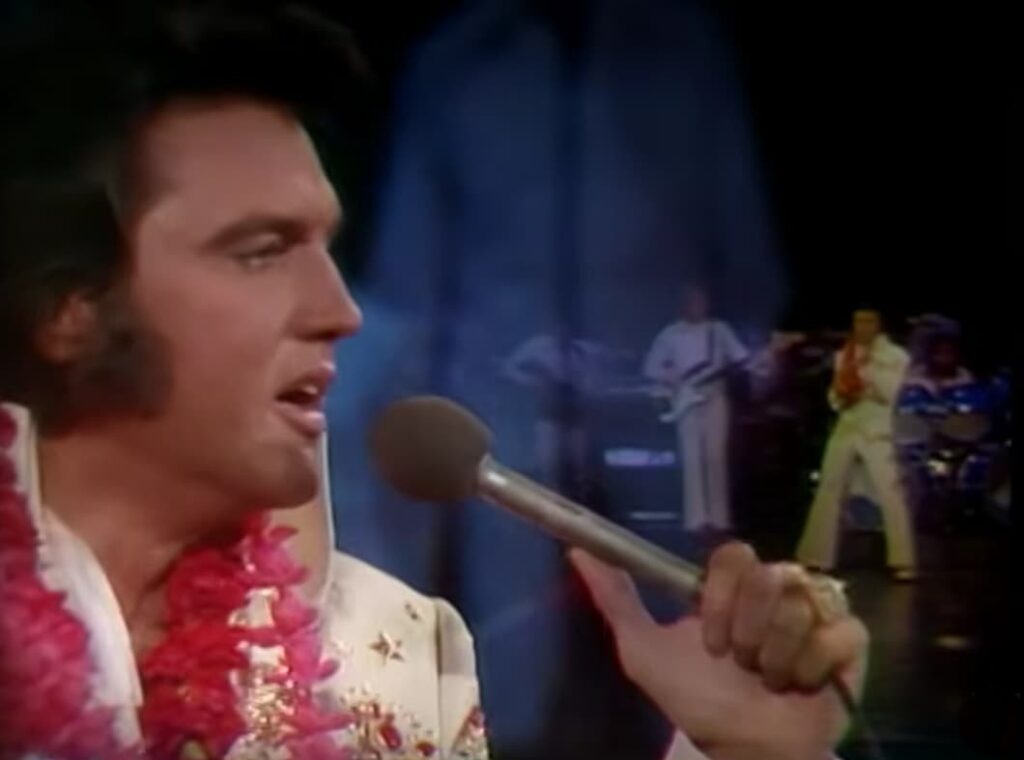
A Global Broadcast That Captured Elvis Presley at the Summit of His Power
When Elvis Presley stepped onto the stage of Honolulu International Center on January 14, 1973, he was doing far more than performing a concert. The event, later released as Aloha from Hawaii via Satellite, became one of the most celebrated moments of his career and one of the defining live music broadcasts of the twentieth century. The accompanying live album, Aloha from Hawaii via Satellite, reached No. 1 on the Billboard album chart and topped both the American pop and country album rankings, reaffirming Elvis’ dominance at a time when many artists struggle merely to remain relevant.
What makes Aloha from Hawaii so remarkable is that it stands as both a triumph and a time capsule. By 1973, Elvis had already conquered rock and roll, survived the changing musical landscape of the 1960s, and reestablished himself through his celebrated comeback years. Yet this concert presented something different: a performer who had evolved beyond youthful rebellion into a commanding, almost mythical figure. Dressed in the now-iconic white American Eagle jumpsuit, he appeared less like a pop star and more like a cultural institution.
Unlike many legendary concerts remembered for controversy or spontaneity, the power of Aloha from Hawaii lies in its extraordinary sense of confidence. Elvis performs as though fully aware of the historical significance of the moment. Songs such as Burning Love, You Gave Me a Mountain, An American Trilogy, and My Way become more than entries in a setlist; they function as chapters in the story of his life and career. Each performance carries a maturity that had not existed in his earliest recordings. The youthful urgency of the 1950s had given way to emotional depth, authority, and reflection.
Thematically, the concert reveals an artist balancing strength and vulnerability. My Way resonates as a declaration of self-determination, while An American Trilogy transforms into a sweeping meditation on history, identity, and national memory. Even the lighter moments showcase Elvis’ gift for connecting with an audience through warmth, humor, and sincerity. The performance feels simultaneously intimate and monumental—an unusual achievement for a show viewed across multiple continents.
Historically, the event occupies a unique place in entertainment history. Broadcast internationally via satellite, it represented the growing possibility of a shared global cultural experience. Millions around the world witnessed the same performance, creating a moment that transcended geography and language. Whether the often-repeated audience estimates have been exaggerated over the years, there is no dispute that the concert became a worldwide phenomenon and one of the most influential television music events ever staged.
Listening today, the enduring appeal of Aloha from Hawaii via Satellite is not merely its scale but its symbolism. It captures Elvis Presley at a rare intersection of artistic mastery, international fame, and cultural significance. The concert preserves a performer still in full command of his voice, his charisma, and his audience. For many listeners, it remains the closest thing to a definitive portrait of Elvis on stage—a moment when the King of Rock and Roll seemed capable of reaching the entire world with a single song.