
The Night Television Finally Surrendered to the Power of a New American Voice
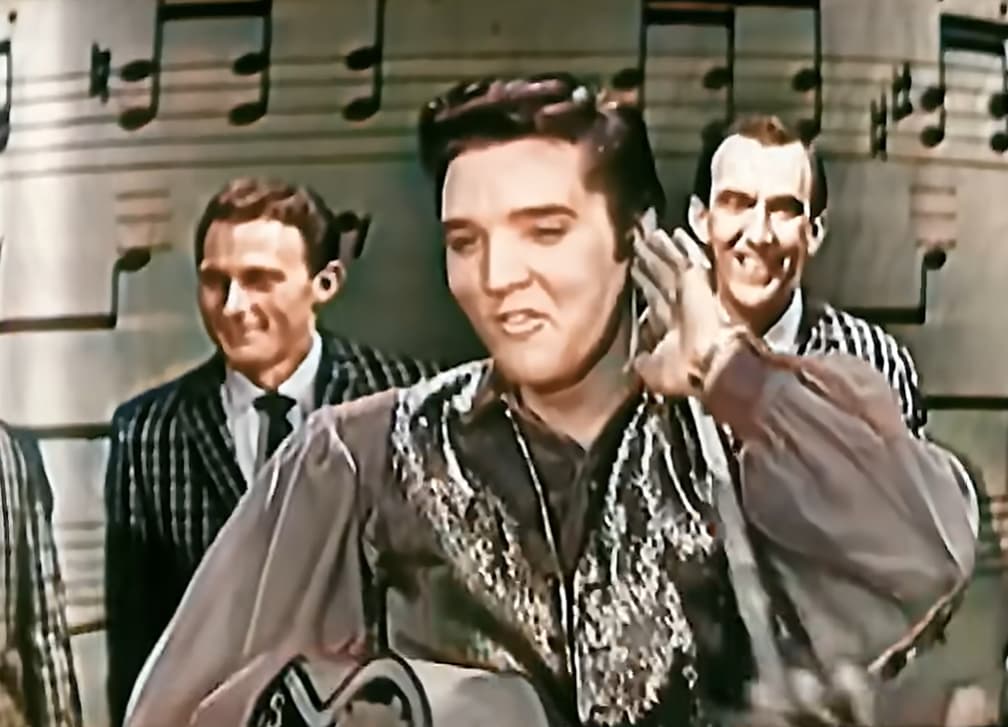
When Elvis Presley stepped onto The Ed Sullivan Show in 1957, he was no longer merely a rising rock-and-roll sensation—he had become the center of a national cultural debate. His third and final appearance on January 6, 1957, came at a moment when songs such as “Too Much” were climbing the charts, with the single ultimately reaching No. 1 on major U.S. sales charts. The performance arrived during one of the most explosive periods of Presley’s career, following the success of Elvis (1956) and on the eve of an extraordinary run of hit records that would define popular music for decades.
Yet the true significance of this appearance cannot be measured by chart positions alone. By early 1957, Elvis had become a symbol of generational change. To millions of young Americans, he represented freedom, excitement, and a new musical language. To many critics and cultural gatekeepers, he embodied a challenge to established norms. The controversy surrounding his stage movements had become so intense that CBS executives famously instructed camera operators to film him only from the waist up during the broadcast. Ironically, the attempt to contain his impact only amplified it.
Watching the surviving footage today, one is struck not by rebellion, but by charisma. The performance reveals an artist standing at the crossroads of several musical traditions. Elvis moved effortlessly between rock and roll, pop balladry, country influences, and gospel. During the broadcast he performed a diverse selection of songs, including “Don’t Be Cruel,” “Too Much,” “When My Blue Moon Turns to Gold Again,” and the deeply spiritual “Peace in the Valley.”
That final song remains one of the most revealing moments of the evening. While history often remembers Elvis as the electrifying young man whose movements shocked television audiences, “Peace in the Valley” showcased another side of his artistry—the gospel singer whose emotional sincerity had been shaped in Southern churches long before fame arrived. The performance carried a quiet dignity that contrasted sharply with the controversy surrounding him and hinted at the spiritual foundation that would remain important throughout his life.
Perhaps the most memorable moment came after the music ended. Host Ed Sullivan, who had initially been reluctant to feature Presley, offered a public endorsement that helped reshape the singer’s image in mainstream America. Praising him as a “real decent, fine boy,” Sullivan effectively gave one of the nation’s most controversial entertainers a seal of approval before an audience of tens of millions. It was more than television etiquette—it was a symbolic moment of acceptance.
Looking back nearly seven decades later, the 1957 Ed Sullivan appearance stands as more than a television performance. It marks the moment when rock and roll ceased to be a passing fad and became part of the American mainstream. The cameras may have been instructed to avoid showing Elvis below the waist, but they could not conceal what truly mattered: a magnetic performer whose voice, presence, and cultural influence were already transforming popular music history.