
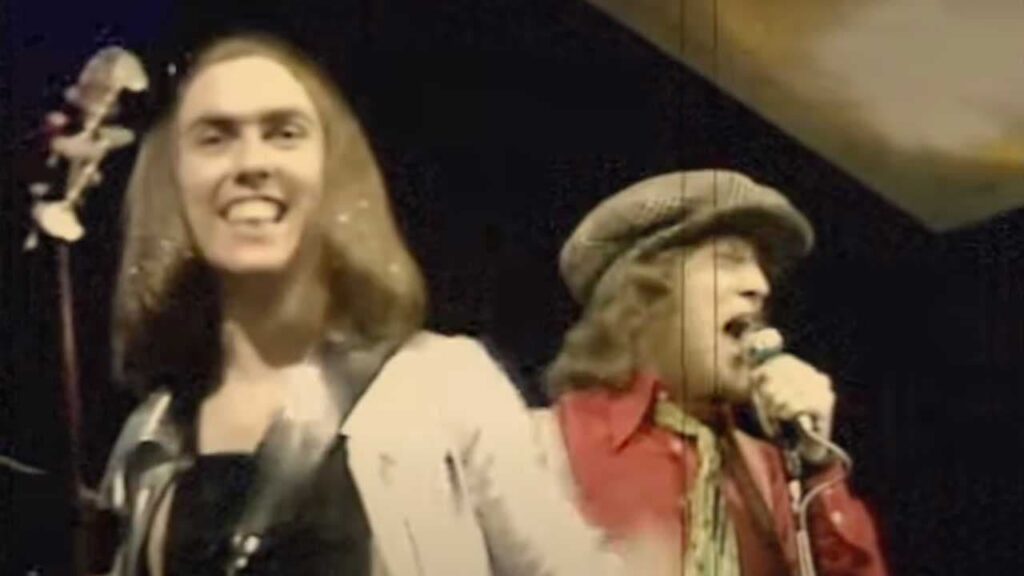
A Band on the Brink of Stardom Captures the Raw Electricity of British Rock at Its Most Unstoppable
When Slade stepped onto the stage at Granada Studios in Manchester in 1972, they were no longer merely a promising working-class rock outfit—they were becoming one of Britain’s defining bands. That year proved pivotal for the group, with hit singles climbing the UK charts and helping establish the commercial momentum that would soon make them household names. The performance commonly known as “Live at Granada Studios, Manchester, 1972” is not tied to a specific studio album in the conventional sense, but rather stands as a remarkable snapshot of Slade during the very period when their explosive popularity was beginning to reshape the landscape of British rock.
What makes this recording so fascinating is not simply the music itself, but the sense of transition it captures. In hindsight, we hear a band standing at the threshold between hunger and triumph. The rough edges remain intact. The swagger has not yet hardened into legend. Every note seems driven by the urgency of musicians who still have something to prove, even as audiences are already beginning to embrace them in enormous numbers.
The genius of Slade was always rooted in contradiction. They possessed the power and volume associated with hard rock, yet their songs carried the immediacy and sing-along accessibility of pop. In the Granada Studios performance, those qualities collide with thrilling force. Frontman Noddy Holder commands attention with a voice that sounds less sung than launched into the room, while the band’s relentless rhythm section creates the kind of communal momentum that defined British live music in the early 1970s.
Viewed through a historical lens, the performance reveals why Slade became such a phenomenon. Many bands of the era excelled in the recording studio, where producers could refine and polish every detail. Slade, however, drew much of their strength from direct human connection. Their music was designed to be experienced collectively—to be shouted back from crowded halls, pubs, and concert venues. Granada Studios may have been a television environment, but the energy feels anything but confined. There is an almost tangible sense of movement, as though the songs are pushing against the limits of the studio walls.
Thematically, the material performed during this period reflects the band’s enduring appeal. Their music celebrates freedom, camaraderie, youthful defiance, and the simple exhilaration of living loudly. These were not songs built upon mystery or poetic abstraction. Instead, they spoke directly to ordinary listeners, transforming everyday emotions into anthems. That honesty remains one of Slade’s greatest strengths and a key reason their work continues to resonate decades later.
Today, “Live at Granada Studios, Manchester, 1972” endures as more than archival footage. It is a vivid document of a band in full ascent—a moment when talent, ambition, and cultural timing aligned perfectly. Watching or listening now, one does not merely witness a performance; one witnesses the sound of British rock discovering one of its most charismatic voices.