
“Old Folks” Turns Glam Rock’s Golden Voice Toward the Quiet Truths of Age and Memory
“Old Folks”, performed by Brian Connolly, belongs to the lesser-known and more intimate chapter of a singer most listeners remember as the unmistakable frontman of The Sweet. Unlike the spectacular singles that made Connolly a defining voice of British glam rock, “Old Folks” was never a charting single and was not part of a conventional studio album released during his lifetime. The recording survives as an early home demo and was later issued among previously unreleased material on the posthumous Take Away the Music collection. The official Sweet archive identifies “Old Folks” specifically as a home demo recorded by Connolly and his writing partner Brian Willoughby at Connolly’s home.
That provenance matters. “Old Folks” is not the polished, arena-sized Brian Connolly of “Ballroom Blitz”, “Fox on the Run,” or “Teenage Rampage.” It comes from another side of his artistic life—a period when Connolly was moving away from the explosive glam-rock identity that had made him famous and exploring more personal, roots-oriented material. After leaving The Sweet in 1979, he pursued a solo career, releasing material that increasingly reflected country-rock and more traditional songwriting influences. His first solo recordings included “Take Away the Music” and “Alabama Man,” while other compositions remained unreleased for years.
The emotional significance of “Old Folks” becomes clearer when viewed within that transition. Accounts from the period describe Connolly spending time at a health farm and speaking with older people there, an experience reportedly connected with his writing of “Old Folks.” Rather than treating the song merely as an archival curiosity, it can be heard as a glimpse into an artist becoming increasingly conscious of time, vulnerability, and the lives that exist beyond the glare of celebrity.
There is something particularly poignant about hearing Connolly approach such material. His voice had once been inseparable from the exuberance of youth: swaggering guitars, pounding rhythms, glitter, attitude, and the theatrical electricity of glam rock. Yet Connolly’s career also carried a darker physical history. In 1974, he suffered a serious assault that damaged his throat and permanently affected the remarkable vocal range he had previously possessed. Against that background, a song concerned with older people acquires an additional resonance—not because the lyric should be forced into autobiography, but because Connolly himself increasingly understood that time leaves marks on every voice.
The title “Old Folks” is deliberately plain. There is no grand mythology in those two words, no romantic disguise. It points toward ordinary people whose stories are rarely granted the spotlight. That simplicity makes the recording feel almost like a conversation rather than a performance. The home-demo setting reinforces that impression: this is music before the machinery of the record industry has polished away its edges. The surviving recordings were transferred from the only known surviving tape of Connolly’s early home demos, and the official archive notes that the original recording method leaves audible distortion in places.
And perhaps that imperfection is precisely why “Old Folks” deserves to be remembered. The roughness becomes part of its emotional architecture. It reminds us that musical history is not made only from hit singles and perfectly mastered albums. Sometimes the most revealing documents are the fragments—the home recordings, unfinished ideas, songs that never received their intended moment in the spotlight.
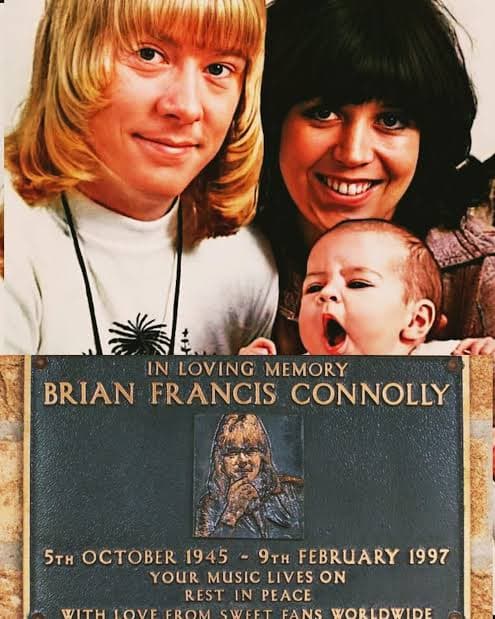
Connolly died in 1997 at the age of 51, leaving behind a career whose most famous chapter had already become part of rock history. But “Old Folks” offers another way of hearing him: not simply as the flamboyant voice of The Sweet, but as a songwriter looking beyond the spectacle toward the quieter human experiences that surround it. In that sense, the recording feels almost like a small room after the concert hall has emptied—a place where the lights are softer, the applause is gone, and what remains is the fragile passage of time.
For listeners willing to look beyond the familiar hits, “Old Folks” is therefore more than an obscure Brian Connolly recording. It is an archival window into an artist searching for a different musical language, and a quietly moving reminder that beneath every era of youthful noise lies the same inevitable story: people grow older, memories remain, and eventually even the loudest voices become part of history.