
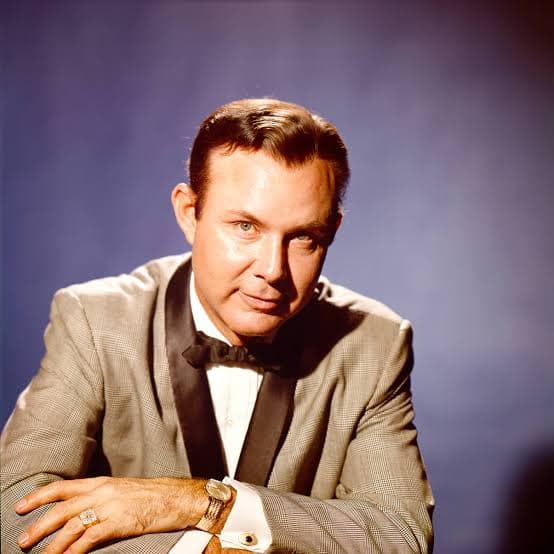
“Distant Drums” turns the sound of approaching war into a heartbreaking plea for love, home, and one last promise
When Jim Reeves released “Distant Drums” in 1966, the song became one of the most remarkable posthumous successes in country music history. Taken from the album Distant Drums, the recording reached No. 1 on the U.S. Billboard Hot Country Singles chart and stayed there for four weeks, while in Britain it became Reeves’ only UK No. 1, spending five weeks at the summit. It also reached No. 45 on the Billboard Hot 100. The achievement was especially poignant because Reeves had died in a plane crash in 1964, nearly two years before the song reached its greatest audience. What makes the record so haunting, however, is not simply the tragedy surrounding its release. It is the extraordinary emotional distance between the song’s gentle voice and the violence waiting just beyond the horizon.
Written by Cindy Walker, “Distant Drums” is built around a deceptively simple situation: a soldier knows that he may soon be called away to war, and before he goes, he wants the woman he loves to marry him. The distant sound of battle becomes more than a literal military signal. It is the sound of time running out. Every moment of tenderness carries the possibility that it may be the last.
That tension gives the song its enduring power. There is no grand battlefield spectacle here, no celebration of military glory, and no attempt to make war heroic. Instead, Walker places the listener inside the private world of two people whose future has suddenly become uncertain. The central emotional question is painfully intimate: what do we promise the person we love when tomorrow can no longer be trusted?
Reeves was uniquely suited to such material. His famous “velvet” voice rarely sounded forceful or theatrical. He sang with restraint, allowing vulnerability to emerge almost imperceptibly. On “Distant Drums,” that restraint becomes part of the storytelling. His delivery does not sound like a man making a dramatic declaration; it sounds like someone speaking quietly because the words matter too much to shout.
The recording itself also carries an unusual history. Reeves had originally recorded the song years earlier, and the version released commercially after his death was completed with overdubs, including orchestral accompaniment. That production decision helped transform a relatively intimate country performance into something broader and more cinematic. Yet the arrangement never overwhelms Reeves. The orchestra seems to widen the emotional landscape around his voice, almost as though the private conversation between two lovers has been placed against an enormous, uncertain world.
There is another historical layer that makes the song particularly fascinating. “Distant Drums” emerged into public consciousness in 1966, during the escalation of the Vietnam War, when the anxieties surrounding soldiers leaving home and families waiting for them were increasingly present in American life. The song therefore acquired a resonance beyond its original narrative. Its story could belong to an earlier generation, yet its emotional circumstances were immediately recognizable to listeners of the 1960s.
In Britain, the song’s impact was extraordinary. It reached No. 1 in September 1966 and remained there for five weeks, even competing with major contemporary releases such as The Beatles’ “Eleanor Rigby” / “Yellow Submarine.” For an American country singer who had already been gone for two years, it was an almost surreal continuation of a career that should have ended.
And perhaps that is the deepest reason “Distant Drums” continues to linger. The song is about a man hearing the distant call of war, but history eventually made Reeves himself the distant voice: a singer preserved on tape, speaking from another era, his warm baritone arriving decades after his final journey. The drums in the song belong to the battlefield, yet Reeves’ voice seems to answer them from the other side of time.
That is the peculiar magic of Jim Reeves. He could make a small human moment feel eternal. On “Distant Drums,” love is not presented as a grand romantic fantasy. It is a shelter against uncertainty—a hand held before departure, a promise made because there may not be another opportunity. And when Reeves sings it with that unmistakable calm, the song becomes more than a country hit. It becomes an elegy for all the promises people make when the future is frighteningly beyond their control.