
“I’m in Love Again” Turns the Simple Shock of Falling in Love into Pure New Orleans Rock ’n’ Roll Joy
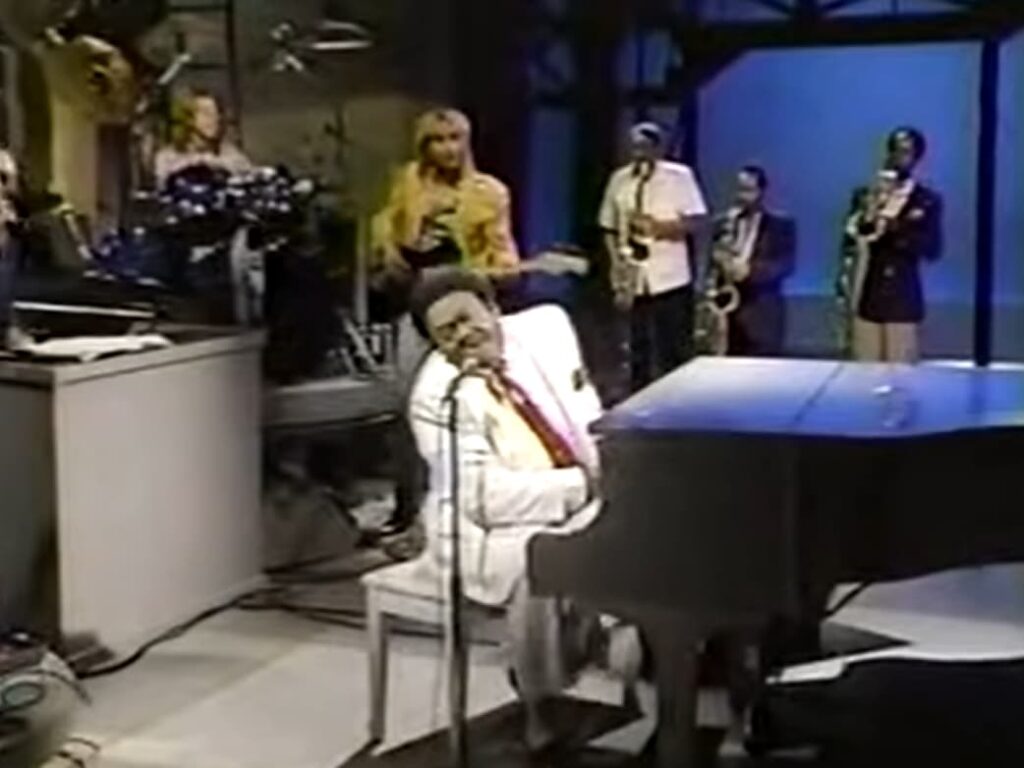
When Fats Domino released “I’m in Love Again” in 1956, the song arrived at one of the most important moments in his career—and in the birth of rock ’n’ roll itself. Written by Fats Domino and his longtime collaborator Dave Bartholomew, the recording was issued by Imperial Records and became a remarkable crossover success: it reached No. 1 on the Billboard R&B chart for seven weeks and climbed to No. 3 on the U.S. pop chart. In Britain, it eventually reached No. 12. The song was also included on Fats Domino Rock and Rollin’, his 1956 Imperial studio album, where it sat among a collection that captured the pianist at the height of his early rock ’n’ roll powers. Yet the version often encountered under the notation “1988” is not a new 1988 studio recording. It refers to a later television performance of a song that had already been written and recorded more than three decades earlier, a reminder of how stubbornly alive Domino’s music remained after its original moment had passed.
There is something almost disarmingly uncomplicated about “I’m in Love Again.” Its emotional vocabulary is not built from grand declarations or elaborate metaphors. The title itself says nearly everything. But that simplicity is precisely where the song derives its power. Domino and Bartholomew understood that romantic exhilaration did not require literary decoration; sometimes the most truthful expression of renewed love is simply the inability to stop announcing it.
The song was recorded in New Orleans in October 1955, with Domino and Bartholomew credited as writers and Bartholomew as producer. That places it firmly inside the extraordinary creative partnership that helped define Domino’s Imperial years. The musical architecture is economical: a compact running time, a buoyant rhythm, Domino’s rolling piano and his unmistakably relaxed vocal delivery. Yet beneath that apparent ease is a sophisticated understanding of rhythm. His piano does not merely accompany the voice; it gives the song its physical momentum, creating the sensation that happiness itself has acquired a beat.
This was one of Domino’s great gifts. His records rarely sounded as though they were trying desperately to make history. They simply sounded good. That quality could obscure how radical they were. Domino’s music emerged from the blues, boogie-woogie and New Orleans rhythm-and-blues traditions while helping shape the emerging language of rock ’n’ roll. His deceptively gentle manner concealed a formidable rhythmic intelligence, and his Imperial recordings became a bridge between R&B audiences and the expanding pop market.
The lyric of “I’m in Love Again” is particularly revealing in that context. Love is presented not as a philosophical problem but as an event that has happened to the singer again—suddenly, irresistibly and happily. There is no tragic mythology surrounding romance here. The song does not ask whether love will last forever. It celebrates the immediate sensation of being swept back into it.
And perhaps that is why the performance still feels so fresh decades later. Fats Domino does not sing as though he needs to convince anyone. He sounds as though he has already discovered the answer and is simply enjoying the pleasure of telling us. The vocal phrasing is warm rather than theatrical, while the piano keeps everything moving forward. It is music without bitterness, but not music without history.
By the time Domino appeared performing the song on television in 1988, rock ’n’ roll had already passed through several generations of transformation. Punk, disco, soul, funk, heavy metal and new wave had all changed the musical landscape. Yet “I’m in Love Again” required no modernization to make its point. The performance demonstrated something increasingly rare in popular music: the ability of an old recording to retain its emotional temperature. The song had not survived because it belonged nostalgically to 1956; it survived because the feeling at its center remained timeless.
That is the deeper legacy of “I’m in Love Again.” It captures Fats Domino before history turned him into a legend, when he was simply a New Orleans pianist with a rolling left hand, a warm voice and an infectious song about discovering love once more. The record became a major R&B and pop success, but its lasting achievement is more intimate. It preserves a fleeting human moment—the sudden realization that, despite everything that came before, the heart is willing to begin again. And when Domino smiles his way through those two minutes, the passage of time seems to loosen its grip.