
“You Never Can Tell” Turns Uncertainty Into One of Country Music’s Most Joyful Celebrations of Life
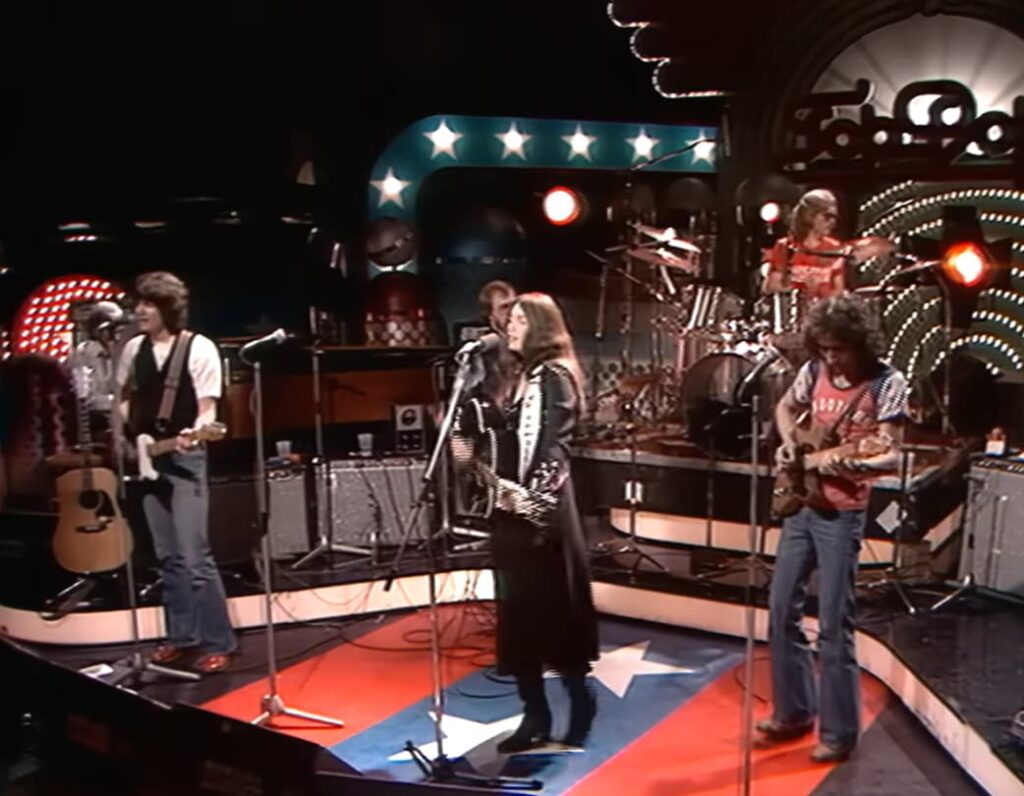
When Emmylou Harris recorded “(You Never Can Tell) C’est La Vie,” she transformed a 1964 rock-and-roll story by Chuck Berry into something unmistakably her own: bright, rootsy, affectionate, and steeped in the easygoing musical language of country and Cajun music. Released as a single in 1977 from Luxury Liner, the song became one of Harris’s most successful crossover moments, reaching No. 6 on Billboard’s country chart. The performance preserved in the 1977 Dutch television program TopPop captures the song in motion, with Harris fronting her celebrated Hot Band and bringing an almost effortless warmth to a composition whose central message is wonderfully simple: life rarely follows the plans people make for it.
The remarkable thing about “You Never Can Tell” is that there is no grand tragedy at its center. Instead, Berry wrote about ordinary happiness—the kind that emerges from modest circumstances and survives precisely because nobody can predict where life will lead. Pierre and his young bride begin with a teenage wedding, a small apartment, inexpensive furnishings, television dinners, and a growing collection of records. Their world is not glamorous, yet the song treats it with genuine affection. The repeated phrase “C’est la vie” becomes less a shrug of resignation than a philosophy: sometimes the future makes fools of our expectations, and sometimes that is a beautiful thing.
Emmylou Harris understood the possibilities within that idea. Her version does not attempt to imitate Chuck Berry. Instead, she hears the song’s underlying New Orleans character and draws it toward the country tradition. The result is a fascinating meeting of musical worlds—rock and roll, country, Cajun color, honky-tonk energy, and the rhythmic buoyancy associated with the Louisiana sound. AllMusic has noted the original’s New Orleans influence and its prominent piano work, while Harris’s recording is particularly distinguished by the Cajun-flavored fiddle contribution associated with Ricky Skaggs.
That musical transformation matters because Harris was always more than a singer of country songs. She was an interpreter, someone capable of entering another songwriter’s world and discovering the emotional truth already hidden there. In “C’est La Vie,” she finds that truth in the contrast between uncertainty and contentment. Pierre and his bride do not know what lies ahead. Neither does the listener. Yet the song suggests that a meaningful life is often built from precisely those small, unplanned moments: finding work, buying a record player, filling a room with music, taking a red car to New Orleans, and discovering that love can endure the unpredictable turns of time.
The 1977 TopPop performance makes that philosophy even more vivid. Recorded on June 20, 1977, the appearance featured Emmylou Harris with her Hot Band, including Glen D. Hardin on piano, Albert Lee on lead guitar, Hank DeVito on pedal steel, Rodney Crowell on guitar, John Ware on drums, and Emory Gordy Jr. on bass. There is a sense of collective musicianship in the performance: nobody seems intent on overpowering the song. Instead, the arrangement moves with the cheerful inevitability of a story that has already learned not to take life too seriously.
That may be the enduring charm of “(You Never Can Tell) C’est La Vie.” Beneath its dancing rhythm and playful details lies a mature observation about existence. We cannot predict whom we will love, where we will live, what fortunes will come our way, or which seemingly ordinary moments will eventually become treasured memories. Chuck Berry supplied the story; Emmylou Harris gave it a country soul. And decades later, the song still sounds like a reminder from an older generation to stop demanding certainty from life. Sometimes the best answer is simply to keep dancing—and let tomorrow reveal itself.