
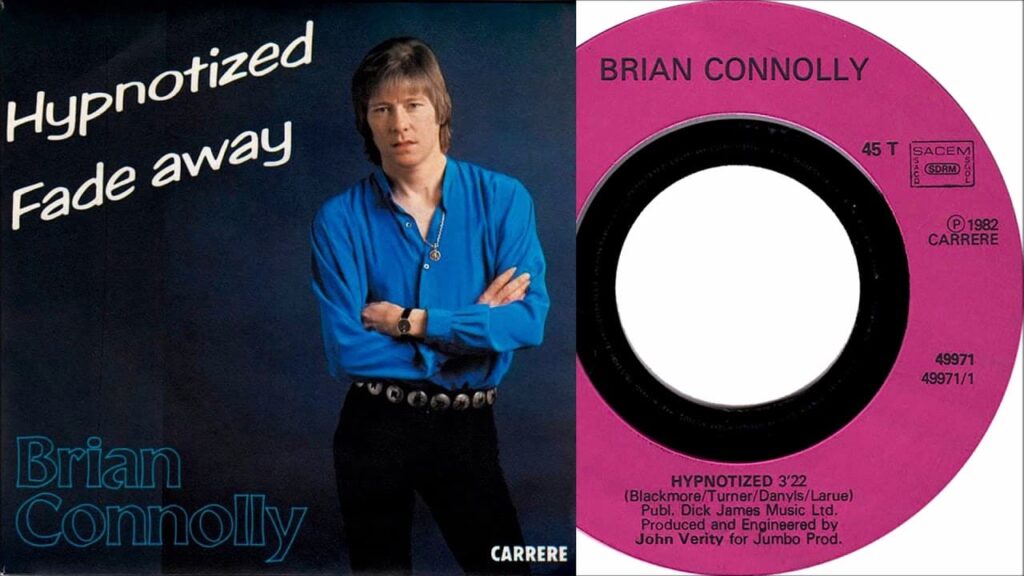
A fragile confession of longing and illusion, where desire becomes both refuge and trap.
Released in 1977, Hypnotized marked a pivotal and quietly revealing moment in the solo career of Brian Connolly, appearing on his self-titled album Brian Connolly and securing a place on the UK Singles Chart upon release. For an artist whose voice had once fronted stadium-sized choruses and glam-rock bravado, this chart entry carried a different weight. It was not the sound of domination or spectacle. It was the sound of exposure. Connolly, no longer sheltered by the collective identity of Sweet, stepped forward alone, offering a song that traded glitter for vulnerability.
At its core, Hypnotized is not about romance in its triumphant form, but about surrender. The song unfolds as a meditation on emotional captivity, where attraction strips away agency and replaces it with quiet submission. Connolly sings not as a conqueror, but as a man fully aware that he is losing control, and perhaps aware that he does not wish to reclaim it. The title itself frames love as a trance, an altered state in which clarity fades and feeling takes command. This is not love that empowers. It enchants, disorients, and disarms.
Musically, the track reflects this psychological tension. The arrangement is smooth and measured, leaning into soft rock and late-seventies pop rather than glam excess. The production avoids sharp edges, allowing the melody to drift rather than strike. This gentler sonic palette creates space for Connolly’s voice, which carries a worn, expressive grain that had deepened over the years. Where earlier performances thrived on theatrical punch, here the phrasing is restrained, almost confessional. Each line feels less sung than admitted.
Lyrically, Hypnotized operates through repetition and insistence. The language circles its central idea, mirroring the mental loop of obsession. There is no dramatic narrative turn, no escape written into the song. Instead, it captures a single emotional condition and holds it steady, asking the listener to sit inside it. This stasis is the point. Hypnosis is not movement. It is suspension. Connolly understands this intuitively, and the song’s structure reflects that emotional paralysis.
In the broader context of his career, Hypnotized stands as a revealing artifact. It shows an artist recalibrating his identity, shifting from flamboyant frontman to reflective storyteller. The song does not attempt to compete with past glories. It does something more honest. It acknowledges change, fragility, and the cost of emotional dependence. For a mature listener, especially one familiar with Connolly’s earlier triumphs, this contrast is where the song’s true power lies.
Decades later, Hypnotized endures not as a forgotten chart entry, but as a document of emotional truth. It captures the moment when illusion is recognized but still embraced, when the spell is understood yet allowed to continue. In that tension, Brian Connolly leaves behind spectacle and gives us something rarer. A quiet, resonant admission of what it means to be willingly undone by feeling.