
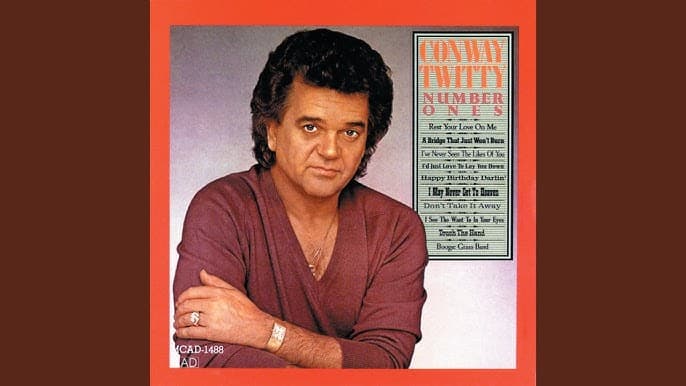
A CELEBRATION OF ROOTS AND RHYTHM IN THE MIDST OF COUNTRY’S EVOLUTION
From the moment Boogie Grass Band hit the airwaves in July 1978, Conway Twitty affirmed that he was not simply a master of heartbreak ballads and honky‑tonk confessionals but a restless artist capable of infusing country music with an exuberant fusion of sound. Issued as the lead single from his album Conway, the song climbed to number 2 on the Billboard Hot Country Singles chart and claimed the top spot on Canada’s RPM Country Tracks chart, adding a spirited uptempo jewel to Twitty’s formidable catalog of hits.
Twitty’s performance on Boogie Grass Band embodies a rare alchemy of reverence and reinvention. At a moment when the late 1970s country landscape was negotiating its identity between traditional forms and crossover sensibilities, the song felt like both a nod to heritage and a call to the dance floor. Written by Ronnie Reno and produced by Owen Bradley, the track stands as a testament to Twitty’s versatility and his uncanny ability to channel multiple strands of American vernacular music without diluting their essential character.
What makes Boogie Grass Band compelling is how it positions itself within the lineage of string‑driven traditions while embracing a buoyant rhythm that suggests a broader cultural conversation. The lyrics celebrate a “new kind of music” with a contagious invitation to “grab your partner and swing her around,” weaving a tapestry of bluegrass imagery with the kinetic pulse of boogie rhythms. There are explicit homages embedded within the text to figures and sounds that shaped American roots music—from the mandolin and banjo of Bill Monroe’s Kentucky bluegrass to the Southern rock swagger of the Allman Brothers’ Ramblin’ Man. This intertextuality situates the song at a crossroads where rural pastiche intersects with contemporary celebratory energy.
Twitty’s baritone anchors the track with a warm confidence that belies the playful subject matter. It is a performance rooted in authenticity, yet unafraid of tongue‑in‑cheek exuberance. The arrangement, driven by brisk tempos and buoyant instrumentation, reflects a country artist at ease with experimentation. In doing so, Twitty expanded the boundaries of what mainstream country could encompass without ever abandoning the genre’s emotional core. Listeners hear in his voice both the lineage of Appalachian folk and the joyful affirmation that music, at its best, invites communal celebration.
In the broader arc of Twitty’s career, Boogie Grass Band occupies a distinct place. Known widely for his ballads of love, loss, and longing, this song reveals a lighter, more communal sensibility in his oeuvre. It captures a moment when country music was not only reflecting on its roots but actively engaging with them in ways that invited the listener to move as much as to feel. The result is a track that, decades later, still feels like an earnest invitation to the dance floor and a vibrant snapshot of a master artist playing joyfully within his craft.