
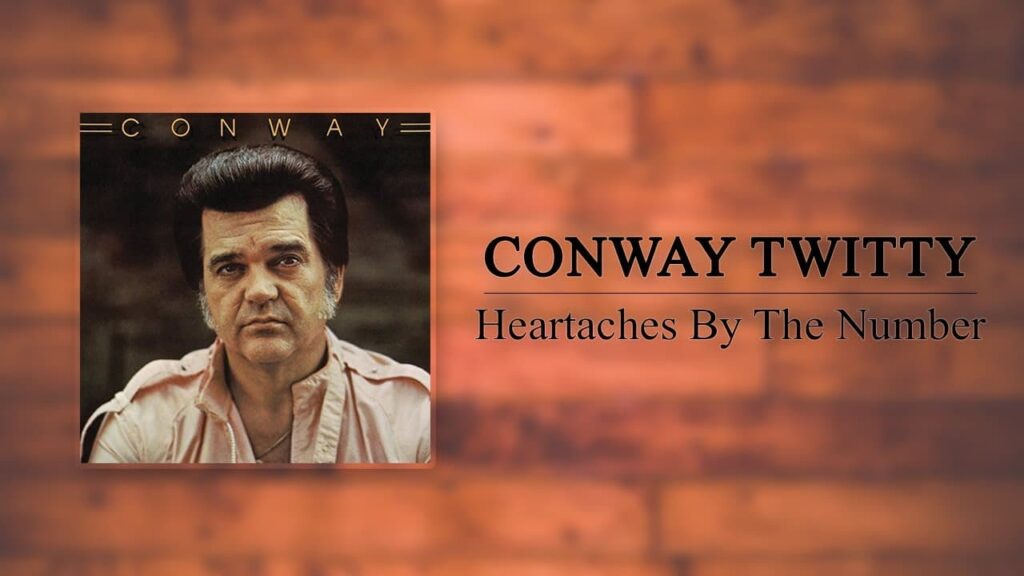
A quiet arithmetic of loss where love is reduced to a tally of wounds that only memory can finish counting
When Conway Twitty recorded Heartaches By The Number, he was engaging with a song that had already carved its place in country music history, having reached the pinnacle of the country charts upon its release and becoming indelibly associated with the genre’s post honky tonk emotional grammar. Twitty’s version appeared on his early Decca era album Saturday Night With Conway Twitty, a period when he was still navigating the space between rockabilly swagger and the deeper pull of country storytelling. The choice itself was revealing. This was not a bid for novelty, but a deliberate alignment with a composition whose emotional clarity had already proven timeless.
At its core, Heartaches By The Number is built on one of country music’s most enduring devices, the transformation of private grief into plainspoken arithmetic. Each heartache is counted, named, and acknowledged, as if emotional survival depends on the act of inventory. The lyric does not dramatize betrayal with rage or spectacle. Instead, it presents heartbreak as something accumulated slowly, almost patiently, through repeated acts of misplaced trust. That restraint is precisely what gives the song its power. Pain is not shouted. It is totaled.
Twitty’s interpretation stands apart not through radical rearrangement, but through tonal intention. Where other versions lean heavily into resignation, Twitty introduces a subtle undercurrent of wounded pride. His vocal delivery retains smoothness, yet there is a controlled tightness in his phrasing, as though each number added to the count costs him something he is reluctant to surrender. This tension reflects where Twitty stood artistically at the time. He was a singer accustomed to charisma and confidence, now momentarily humbled by a lyric that allows no illusion of control.
Musically, the song’s straightforward structure works in service of its theme. The melody circles back on itself with almost mechanical inevitability, reinforcing the sense that heartbreak is not a surprise but a process. Each chorus feels less like a refrain and more like a ledger being updated. Twitty’s voice, polished yet vulnerable, becomes the human element against that emotional machinery. He does not plead for sympathy. He simply reports the damage.
Culturally, Heartaches By The Number endures because it articulates a universal recognition that love often teaches through repetition rather than revelation. There is no singular moment of collapse in the song, only the slow realization that hope has been overdrawn. Twitty’s rendition contributes to that legacy by bridging eras. It carries the emotional directness of classic country while hinting at the smoother, more romantic persona he would later perfect.
In listening to Conway Twitty sing Heartaches By The Number, one hears more than a cover of a celebrated standard. One hears an artist learning, in real time, how restraint can speak louder than bravado. The numbers add up. The lesson remains.