
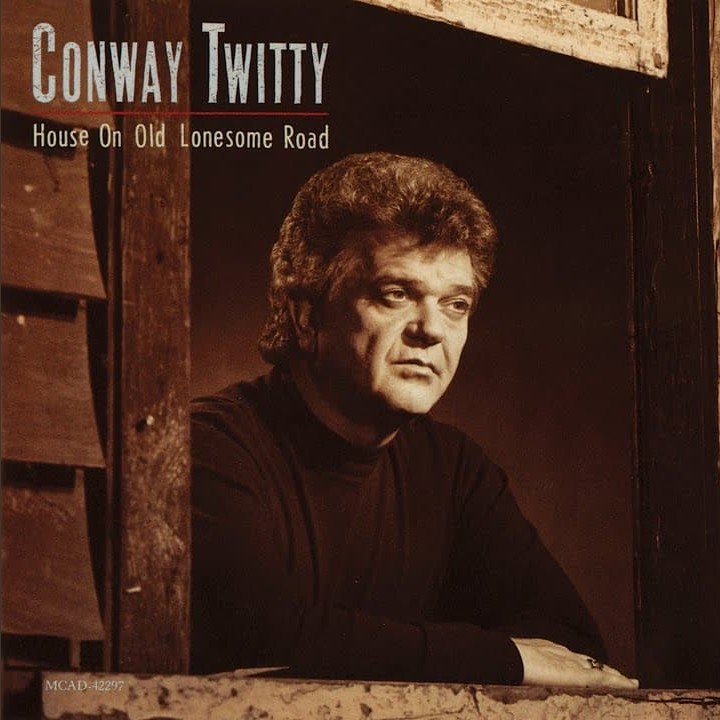
A song about choosing solitude not as punishment, but as the only honest refuge left after love has burned itself out
Upon its release in 1989, House On Old Lonesome Road climbed to Number One on the Billboard Hot Country Singles chart, affirming Conway Twitty once again as one of country music’s most reliable interpreters of adult emotional truth. The song also served as the title track of his album House On Old Lonesome Road, a late career statement that found Twitty sounding neither nostalgic nor resigned, but sharply aware of the emotional terrain he had spent decades mapping. By this point, chart success was almost expected of him. What mattered more was how effortlessly he continued to give voice to feelings many listeners struggled to articulate for themselves.
At its core, House On Old Lonesome Road is not merely a breakup song. It is a meditation on consequence. The narrator is not abandoned, nor blindsided by loss. He arrives at loneliness knowingly, even deliberately. The road in the title is not a place one stumbles onto. It is chosen, walked with eyes open, because the alternatives have been exhausted or proven dishonest. This distinction is crucial. Twitty does not sing as a victim of circumstance, but as a man who understands that certain emotional costs must be paid in full.
The song’s power lies in its restraint. The lyric avoids melodrama, favoring images that feel lived in rather than invented. A house, a road, distance from former warmth. These are simple symbols, but in Twitty’s hands they become weighty. The house is not described as empty, yet it is unmistakably lonely. The absence is implied, not announced. This approach mirrors real heartbreak, where the loudest moments are often internal, and the world outside remains stubbornly ordinary.
Musically, the arrangement supports this emotional economy. The tempo is unhurried, the instrumentation traditional and unobtrusive. Nothing competes with the vocal. Twitty’s voice, by this stage of his career, carried a weathered authority that younger singers could not manufacture. He sounds settled into the truth of the song. There is no pleading, no anger, no attempt to reverse time. What remains is acceptance, tinged with regret but free of self deception.
Culturally, House On Old Lonesome Road arrived at a moment when country music was beginning to embrace slicker production and broader crossover appeal. Twitty, however, stayed anchored in emotional realism. His continued chart dominance with songs like this proved that audiences still craved narratives rooted in adult experience. Love that fails. Choices that cannot be undone. Solitude that follows not as tragedy, but as resolution.
In retrospect, the song stands as one of Twitty’s most quietly definitive recordings. It encapsulates what made him essential to country music history. Not vocal fireworks, not novelty, but the ability to inhabit a song so completely that it feels less like performance and more like confession. House On Old Lonesome Road endures because it does not ask for sympathy. It offers recognition. For listeners who have ever understood exactly why they had to leave, even when it hurt, this song remains an unspoken companion waiting at the end of a long, familiar road.