
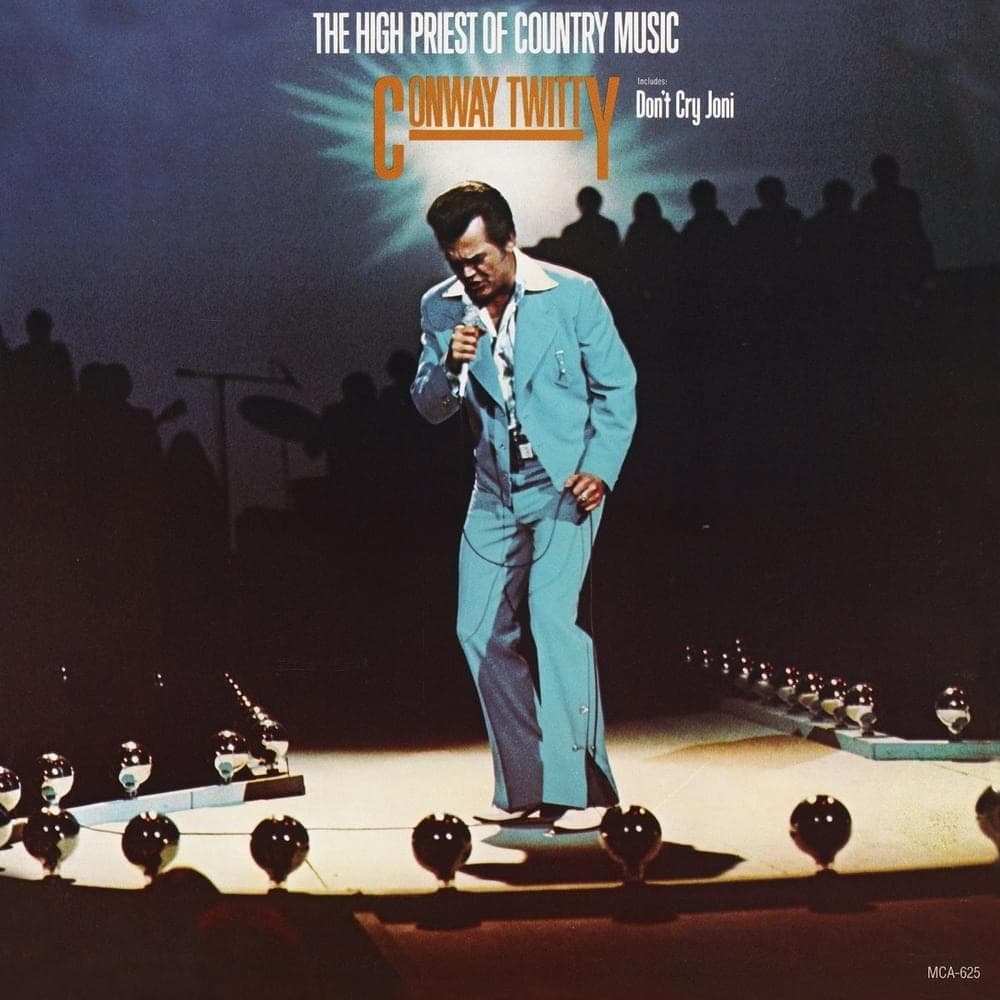
A portrait of emotional imbalance, where love collapses under the weight of unequal longing.
Upon its release in 1971, “I’m Goin Crazy And She’s Just Goin” climbed to number one on the Billboard Hot Country Singles chart, securing yet another defining hit for Conway Twitty. The song appeared on his album Mr. T, a record that captured Twitty at a moment of artistic certainty, when his voice, his phrasing, and his emotional instincts were fully aligned with the direction of country music’s adult realism. By this point in his career, Twitty was no longer proving himself. He was documenting the emotional lives of his listeners with quiet authority.
At its core, “I’m Goin Crazy And She’s Just Goin” is a study in emotional asymmetry. The title itself establishes the imbalance with devastating clarity. One person is unraveling, consumed by loss and confusion. The other is simply leaving, emotionally detached, unburdened, already moving forward. Twitty does not dress this situation in melodrama. Instead, he presents it as an observation, almost clinical in its honesty. That restraint is precisely what gives the song its power.
The lyric unfolds from the perspective of a man who understands that the relationship has ended but cannot reconcile how differently the ending is experienced on each side. His pain is not rooted in betrayal or anger, but in the quiet shock of realizing that love does not always dissolve evenly. Where one heart fractures, the other walks away intact. This theme, painfully familiar to anyone who has lived long enough to lose, is handled with remarkable economy. There are no grand metaphors, no ornate turns of phrase. The song trusts the truth to speak for itself.
Musically, the arrangement reinforces this emotional divide. The tempo is steady, unhurried, almost indifferent, mirroring the calm departure of the woman in the song. Against this measured backdrop, Twitty’s voice carries the entire emotional burden. He sings with a controlled ache, never breaking into overt anguish. That control is essential. It suggests a man trying to maintain dignity while coming apart internally. The ache is not shouted. It is contained, and therefore more believable.
What distinguishes Twitty’s performance is his understanding of space. He allows pauses to linger, lets syllables stretch just enough to suggest hesitation, disbelief, and resignation. This is not the sound of a man pleading for reconciliation. It is the sound of someone narrating his own emotional collapse in real time, aware that nothing he says will change the outcome.
Culturally, “I’m Goin Crazy And She’s Just Goin” stands as an example of country music’s shift toward emotional realism in the early 1970s. It rejects moral lessons and clear villains. No one is condemned. No one is redeemed. There is only the quiet recognition that love can end without symmetry or mercy. In that recognition lies the song’s enduring resonance.
Decades later, the record remains unsettling in its accuracy. It reminds the listener that heartbreak is not always dramatic. Sometimes it is simply watching someone leave while you stay behind with the weight of feeling they no longer carry. In capturing that moment with such precision, Conway Twitty did not just score another chart topper. He etched a permanent emotional truth into the vinyl history of country music.