
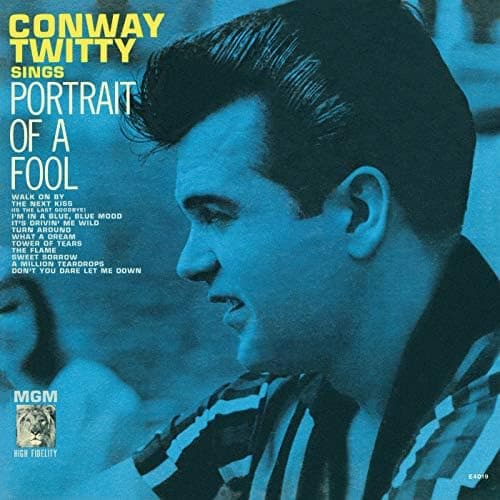
A man stands before love’s wreckage, forced to see himself not as a victim, but as the architect of his own heartbreak
When Conway Twitty released Portrait of a Fool, it found its place within the deeply introspective landscape of his early 1970s output, appearing on the album I Wonder What She’ll Think About Me Leaving. The song resonated strongly with country audiences, climbing into the upper reaches of the Billboard country chart and reinforcing Twitty’s reputation as one of the genre’s most emotionally persuasive voices. At a time when his transition from rock and roll into country had fully matured, this recording exemplified the narrative depth and vocal control that would define his most enduring work.
At its core, Portrait of a Fool is not merely a lament. It is an act of confrontation. Where many country ballads of heartbreak position the singer as wounded but blameless, Twitty delivers something far more unsettling. The narrator does not point outward. He turns inward, examining his own reflection with an almost brutal clarity. The “portrait” in question is not painted by circumstance, but by choice, regret, and the slow realization that love has been squandered through neglect or pride.
Twitty’s vocal performance is central to this emotional architecture. His phrasing carries a restrained intensity, never tipping into melodrama, yet never retreating from the weight of the lyric. There is a deliberate pacing in the way he unfolds each line, as though each word must pass through memory before reaching the listener. This technique creates an intimacy that feels less like performance and more like confession. In the hands of a lesser vocalist, the song might risk sentimentality. In Twitty’s delivery, it becomes something closer to quiet reckoning.
The arrangement mirrors this emotional restraint. Traditional country instrumentation provides a steady, almost understated backdrop, allowing the narrative to remain at the forefront. There are no grand gestures in the production. Instead, the song leans into space and subtlety, reinforcing the sense that this is a private moment made public. The listener is not invited to observe from a distance, but to stand uncomfortably close to the truth being revealed.
Within the broader arc of Conway Twitty’s career, Portrait of a Fool reflects a period where his music increasingly explored the complexities of adult relationships. Gone were the simpler expressions of longing that defined much of his earlier work. In their place emerged songs that acknowledged responsibility, consequence, and emotional ambiguity. This shift aligned him with a generation of country artists who were redefining the genre’s emotional vocabulary, moving beyond archetypes into something more psychologically nuanced.
What gives Portrait of a Fool its enduring power is its refusal to offer redemption. There is no promise that the damage can be undone, no suggestion that understanding will lead to forgiveness. Instead, the song lingers in that moment of recognition, where the truth has been seen too clearly to ignore. It is in this stillness that Twitty achieves something remarkable. He transforms a simple narrative of lost love into a meditation on self-awareness, where the greatest heartbreak is not losing someone else, but finally understanding oneself too late.