
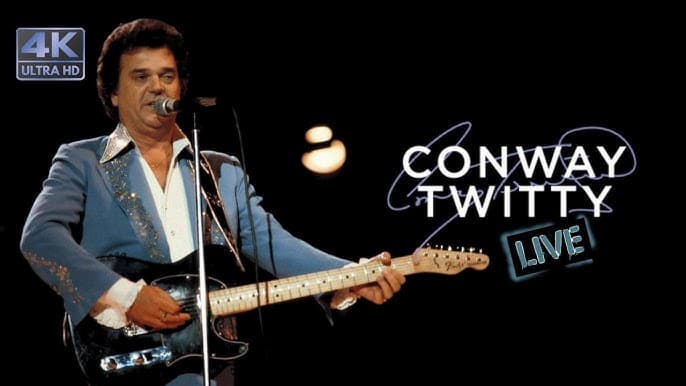
A Voice Built for Heartbreak Became Even More Human Under the Stage Lights
When Conway Twitty stepped onto the stage for Live In Concert, he was no longer simply the polished hitmaker responsible for a staggering run of country classics. He was something rarer: a performer exposing the raw mechanics of loneliness, desire, regret, and devotion in real time. Unlike the carefully sculpted atmosphere of his studio albums, the live setting stripped away distance. The audience could hear the grain in his voice, the hesitation between lines, the ache buried beneath his famously smooth phrasing. That was always Conway Twitty’s hidden strength. He sang love songs as though he had survived every one of them.
By the time these concert recordings circulated among fans, Twitty had already become one of country music’s defining voices, a man whose catalog dominated radio throughout the 1970s and 1980s. His studio work consistently climbed the country charts, and albums bearing his name had become synonymous with emotional realism. Yet a live performance revealed dimensions that records alone could never fully capture. There was an intimacy in the room that transformed familiar songs into confessions.
What makes Live In Concert enduring is not spectacle. Twitty was never dependent on elaborate showmanship. He understood something older and more difficult: stillness. He knew how to let silence hang for half a second before delivering a line that landed like memory itself. In concert, songs about broken relationships did not feel theatrical. They felt lived in. His voice carried the exhaustion of middle age, the vulnerability of a man who understood that romance rarely survives untouched by disappointment.
That emotional honesty separated him from many of his contemporaries. Conway Twitty did not sing as the untouchable cowboy hero. He sang as the man sitting alone after the dance hall emptied. Even at the height of his fame, there was always something deeply personal in his delivery, almost conversational. Audiences responded because they recognized themselves inside the songs. The heartbreak was ordinary. The longing was ordinary. And because it was ordinary, it became universal.
The live environment also highlighted his extraordinary command of phrasing. Twitty had a remarkable instinct for restraint. He rarely overreached vocally, rarely forced emotion where a whisper would suffice. That subtlety gave his performances enormous emotional weight. A single drawn-out syllable could sound like resignation. A quiet pause could imply years of regret. Few singers in country music understood emotional pacing with such precision.
There is also an important cultural truth embedded within performances like these. Conway Twitty emerged during a period when country music was increasingly balancing traditional storytelling with commercial polish. In concert, however, the artifice disappeared. What remained was the oldest function of country music itself: testimony. Songs became stories exchanged between strangers who shared the same wounds.
That is why recordings like Live In Concert continue to resonate decades later. They preserve not only a singer at work, but a disappearing kind of emotional communication. Conway Twitty belonged to an era when performers trusted vulnerability more than image, and when audiences came to concerts searching not merely for entertainment, but recognition. Under the lights, with nothing but that unmistakable voice carrying across the room, he gave them exactly that.