
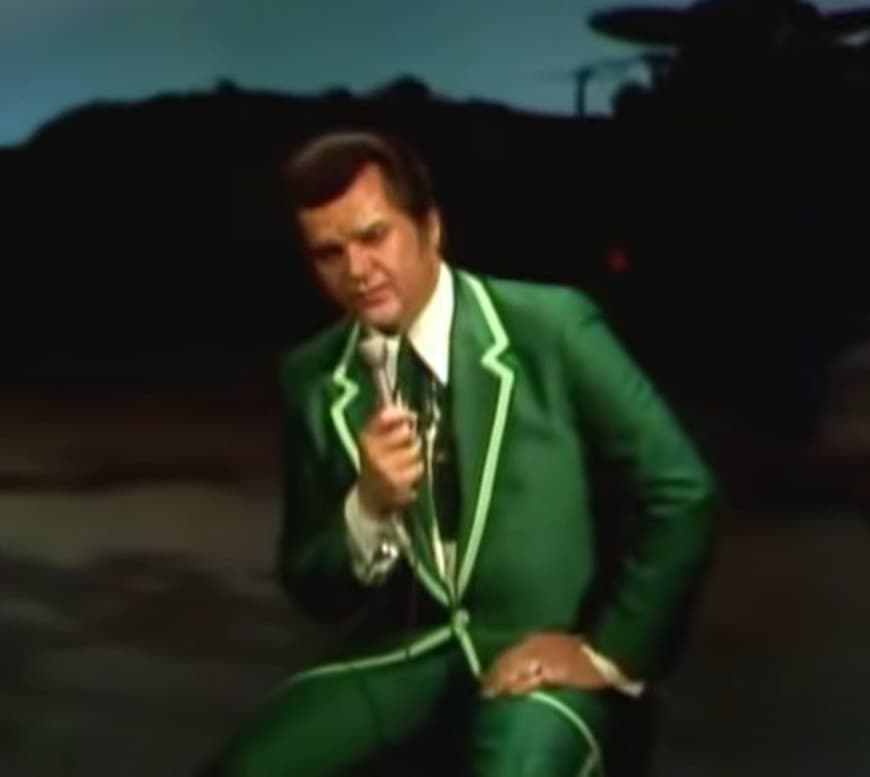
A Farewell Spoken Too Late Becomes a Lifetime of Regret
When Conway Twitty released “(Lost Her Love) On Our Last Date” in 1972, the song quickly became one of the defining moments of his extraordinary country career. Adapted from Floyd Cramer’s celebrated 1960 instrumental “Last Date,” Twitty transformed a wordless melody into a heartbreaking narrative of remorse and lost love. The single reached No. 1 on the Billboard Hot Country Singles chart, becoming his seventh solo country chart-topper and spending thirteen weeks on the chart. It was later featured on the album I Can’t Stop Loving You / (Lost Her Love) On Our Last Date, a record that further cemented Twitty’s dominance during country music’s golden era.
What makes “(Lost Her Love) On Our Last Date” so enduring is not simply its tale of heartbreak, but the particular kind of heartbreak it explores. Many country songs tell stories of betrayal, abandonment, or fate. Twitty’s song is more painful because the loss is self-inflicted. The narrator is not a victim of circumstance; he is a man forced to live with the consequences of his own decision.
The song unfolds like a confession spoken years after the fact. A young man ends a relationship, convinced he is doing the right thing. In a moment of emotional blindness, he removes the ring from his lover’s finger, wipes away her tears, and walks away. Only afterward does understanding arrive. By then, of course, it is useless. The tragedy lies in the timing. Wisdom comes too late.
This theme has always occupied a special place in country music. Regret is often more devastating than loss itself because it offers no enemy to blame. Twitty understood this emotional terrain better than almost any singer of his generation. His voice carries the weight of hindsight, sounding less like a performer delivering lyrics and more like a man revisiting a memory he wishes he could rewrite.
Musically, the song retains the haunting elegance of Floyd Cramer’s original composition. The melody moves with a gentle, almost resigned sadness, allowing every line to linger. Rather than overwhelming the listener with dramatic instrumentation, the arrangement creates space for reflection. Each note feels suspended between memory and realization, perfectly matching the song’s emotional architecture.
There is also a remarkable maturity in Twitty’s songwriting. He avoids melodrama and grand declarations. Instead, he focuses on a simple truth: sometimes the most significant mistakes in life are made quietly. A single decision, made in a moment of uncertainty, can echo for decades. That understated realism is what gives the song its lasting power.
More than fifty years after its release, “(Lost Her Love) On Our Last Date” remains one of Conway Twitty’s most poignant recordings. It stands as a meditation on youth, pride, and the painful clarity that often arrives only after love has disappeared. In the vast catalog of country heartbreak songs, few capture the ache of realizing what you had only after you’ve let it go quite so beautifully.