
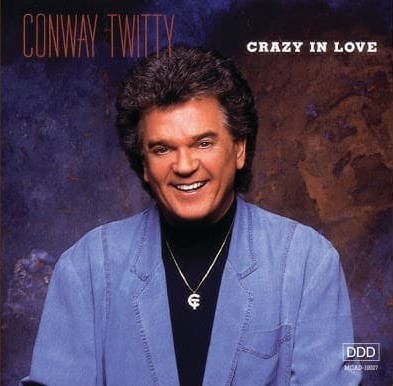
Man confronts the quiet terror of loving in the shadow of another’s memory.
When Conway Twitty released “Nobody Can Fill Your Shoes” in 1979, the single quickly climbed to No. 1 on the Billboard Hot Country Singles chart, reaffirming his dominance during one of the most fertile stretches of his career. The song appeared on the album Cross Winds, a record that captured Twitty at a moment of polished maturity, his voice deepened by years of heartbreak ballads and honky-tonk confessions. By the end of the decade, he was no longer merely a country star; he was an institution, and this recording stands as one of the era’s defining emotional statements.
At its core, “Nobody Can Fill Your Shoes” is not about rivalry or jealousy in the conventional sense. It is about the existential burden of loving someone who has loved before. The narrator is not competing with a living presence but with a memory, with a ghost that lingers in the quiet spaces of a relationship. In country music, where loss and longing are familiar terrain, Twitty’s interpretation gives the theme a psychological precision. He does not raise his voice. He does not plead. Instead, he delivers the lines with a restrained ache, as if already bracing for inevitable disappointment.
Musically, the arrangement is deceptively gentle. Steel guitar sighs behind him like a distant echo of regret. The rhythm section moves with steady inevitability, mirroring the emotional undercurrent of resignation. Twitty’s baritone, smooth yet edged with vulnerability, becomes the central instrument. His phrasing lingers just slightly behind the beat, creating the sensation of a man thinking in real time, measuring each confession before letting it fall.
What makes the song endure is its emotional honesty. There is no bravado in admitting that love may never be fully reciprocated. The narrator recognizes that devotion alone cannot erase history. In many ways, this is one of Twitty’s most adult performances. It acknowledges that relationships carry scars, that the past is not so easily dismissed, and that sometimes love demands the humility to stand in second place.
Within the broader arc of Conway Twitty’s career, the song exemplifies his singular gift: transforming private insecurity into universal testimony. Throughout the 1970s, he became known for intimate, emotionally direct storytelling, and “Nobody Can Fill Your Shoes” distills that approach to its essence. It is not dramatic in scale, but it is profound in implication.
Long after its chart triumph faded into statistics, the song remains a study in emotional realism. It captures the quiet dread of loving someone whose heart still echoes with another name, and it does so with a grace that only Twitty could summon.