
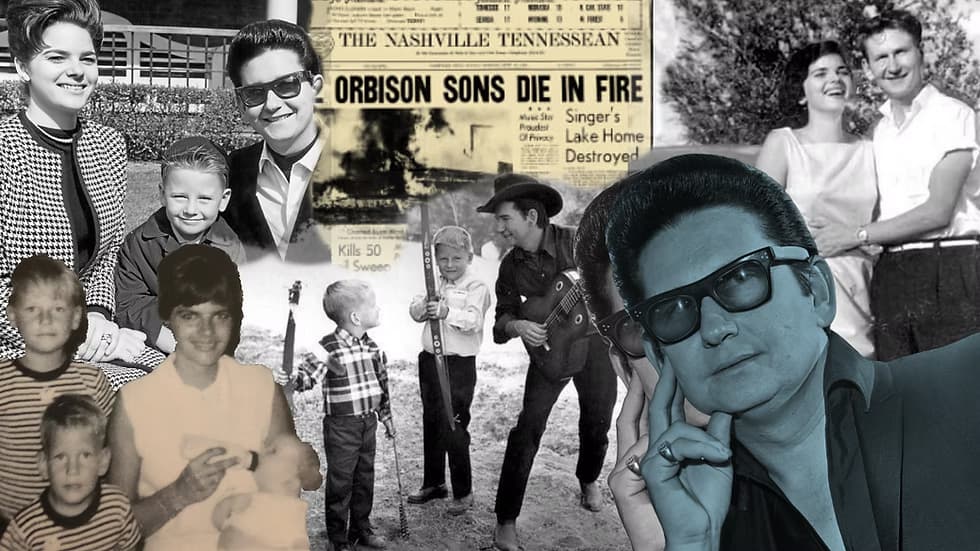
A voice untouched by time, yet forever marked by loss that reshaped the man behind the music
At the height of his career, Roy Orbison stood as one of the most distinctive voices in popular music, his operatic ballads redefining the emotional reach of rock and roll. His success throughout the early 1960s, with monumental recordings under Monument Records and albums such as Crying, placed him firmly among the era’s elite. Yet behind the soaring crescendos and haunting vulnerability of his music lay a series of personal tragedies that would profoundly alter both his life and artistic identity.
The late 1960s marked a devastating turning point. In 1966, Orbison’s first wife, Claudette, was killed in a motorcycle accident, an event that shattered the emotional foundation of his private life. Not long after, in 1968, a house fire claimed the lives of two of his young sons. These were not mere setbacks in the narrative of a performer’s career; they were catastrophic losses that carved deeply into the psyche of a man already known for channeling loneliness and longing into song.
What makes this chapter in Orbison’s life so compelling is the eerie symmetry between his art and his reality. Long before these tragedies, his voice had already carried an almost preternatural sense of sorrow. Songs like Only the Lonely and Running Scared seemed to anticipate heartbreak with an intensity uncommon even among his contemporaries. After these events, however, that emotional weight was no longer interpretive. It became lived experience. The melancholy that once felt theatrical now carried the gravity of truth.
In the years that followed, Roy Orbison withdrew somewhat from the mainstream spotlight. The changing musical landscape of the late 1960s and early 1970s, dominated by new sounds and shifting cultural tides, coincided with his personal retreat. Yet even in relative quiet, his influence did not diminish. If anything, it deepened. Fellow musicians and later generations would come to recognize the unique architecture of his music: the absence of traditional choruses, the gradual, almost cinematic build of tension, and that unmistakable voice rising into a near-operatic climax.
His eventual return to prominence in the 1980s was not framed as a comeback in the conventional sense. It felt more like a rediscovery, both by audiences and by Orbison himself. The formation of the Traveling Wilburys and his later recordings revealed an artist who had endured unimaginable loss yet retained the capacity for creative renewal.
To understand Roy Orbison is to confront the delicate interplay between beauty and grief. His tragedies did not define his artistry, but they irrevocably shaped its emotional depth. When he sang of loneliness, it was no longer abstraction. It was memory, echoing through every sustained note, reminding listeners that behind one of the most beautiful voices ever recorded stood a man who had seen the darkest edges of life and continued, somehow, to sing.