
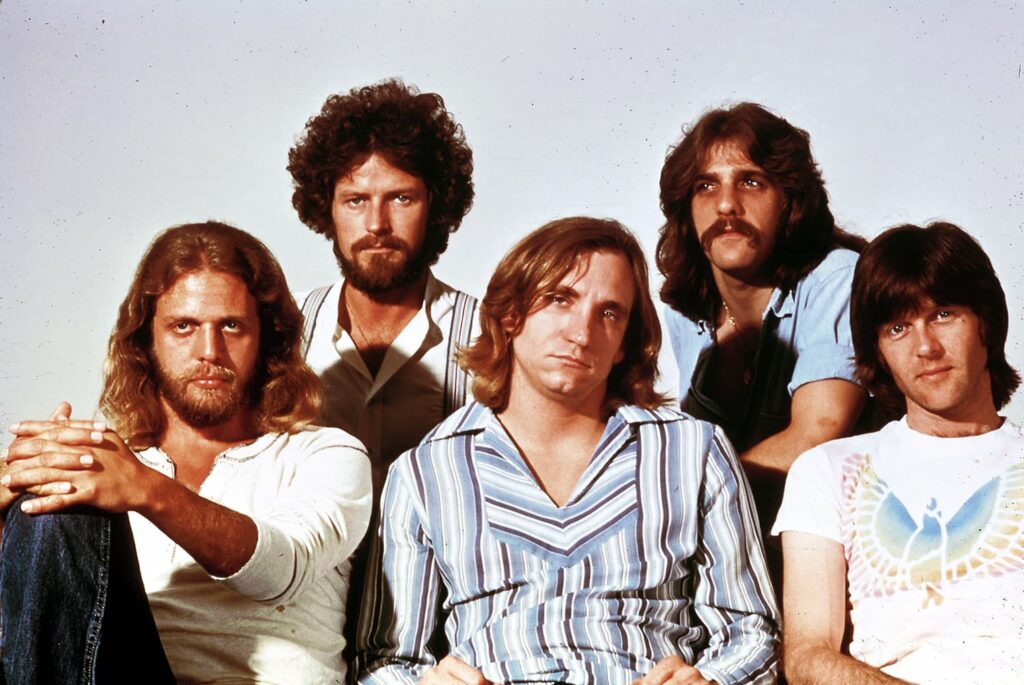
A haunted journey through excess, illusion, and the quiet terror of never truly leaving.
Upon its release in late 1976, Hotel California by Eagles quickly ascended to the summit of popular culture, reaching No. 1 on the Billboard Hot 100 in May 1977 and anchoring the album Hotel California, which itself became a defining commercial and artistic triumph of the band’s career. Issued as the title track and later awarded the Grammy for Record of the Year in 1978, the song arrived not merely as a hit single, but as a cultural event, one that signaled the end of American rock’s innocence and the beginning of a more reflective, uneasy era.
At its surface, Hotel California unfolds like a cinematic short story. A lone traveler, weary from the road, stumbles upon a glowing refuge in the desert night. Yet the longer he stays, the more the welcome curdles into something unsettling. This narrative ambiguity is precisely where the song derives its enduring power. Written primarily by Don Felder, Don Henley, and Glenn Frey, the composition merges Felder’s hypnotic chord progression with Henley’s lyrics, which function less as a linear tale than as a symbolic landscape. The hotel is not a place. It is a state of mind.
Lyrically, the song interrogates the seductive excess of American success in the mid 1970s, particularly within the California music industry. Lines like “You can check out any time you like, but you can never leave” resonate as a quiet indictment of fame’s psychological trap. The luxury, the beauty, and the constant indulgence come at a cost that is never itemized, only felt. There is no villain here, only complicity. The guests participate willingly, even gratefully, until they realize the bill cannot be paid with money.
Musically, Hotel California is a masterclass in controlled tension. The steady, almost Latin influenced rhythm lulls the listener into comfort, while the minor key atmosphere sustains an undercurrent of unease. The song’s famous dual guitar solo, performed by Felder and Joe Walsh, does not explode in rebellion. Instead, it unwinds slowly, methodically, as if tracing the inevitability of the narrator’s fate. It is one of rock music’s most studied and revered instrumental passages, not for speed or flash, but for its narrative clarity. The guitars speak when words are no longer sufficient.
Decades later, Hotel California remains endlessly debated, misinterpreted, and mythologized. Yet its greatness lies in its refusal to provide a definitive answer. It does not preach or accuse. It observes. In doing so, it captures a universal fear beneath its Californian sheen. The fear that what we desire most may become the very thing that confines us. That realization, whispered rather than shouted, is why this song still lingers long after the final chord fades.